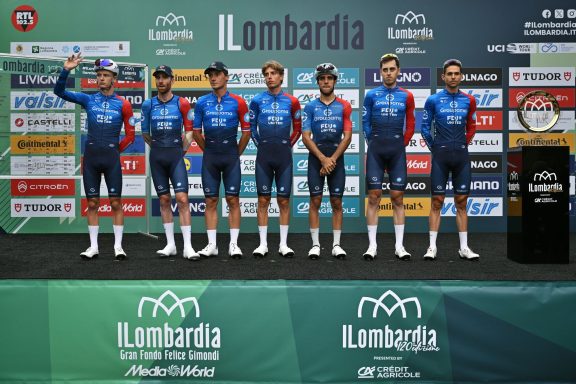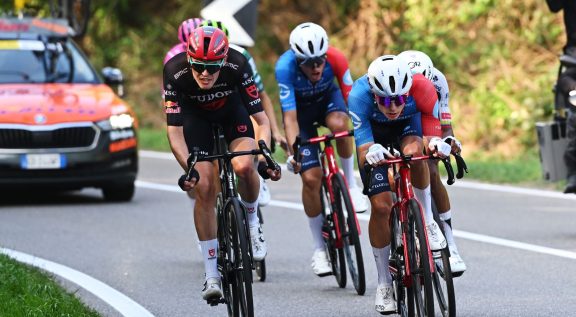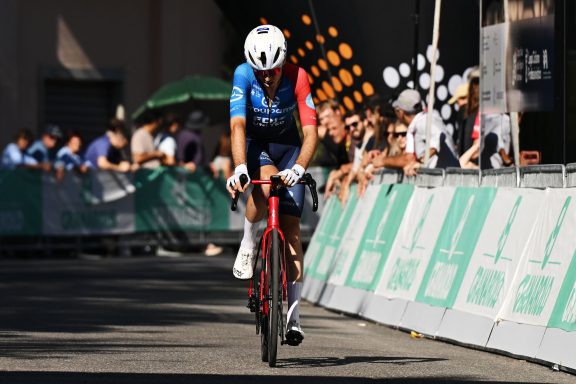

On Belgian roads, boldness did not pay off this Friday. Romain Grégoire was in fact one of the main protagonists of De Brabantse Pijl, which he himself shook up 30 kilometres from the finish. Gradually joined by a few riders, the Frenchman stayed at the front of the race until the final kilometre, before being caught at the last moment by the peloton. In a frantic sprint finish, he still found the strengths to secure a solid but frustrating fourth place.
As the “Ardennes Classics” approach, just days after the end of the “Flemish Classics,” the peloton took on a race this Friday that sits somewhere between the two categories. De Brabantse Pijl offered a rolling course, with several cobbled climbs on the finishing circuit in Overijse. This circuit, to be completed three times, featured four hills, only two of which were paved, unlike the Hertstraat and the Moskesstraat. After nearly 100 kilometres of racing, the peloton began the first lap around the finishing town, with the Groupama-FDJ United cycling team initially covering attacks launched by rival teams. Shortly before the second passage over the line, the early breakaway was reeled in, and a new race began. Romain Grégoire and his teammates tried to handle it as best as possible, first getting over the Hertstraat in good position before Lorenzo Germani and Kevin Geniets perfectly set up their leader at the foot of the Moskesstraat (500m at 8%). The punchy Frenchman then showed his strengths, breaking away solo before being joined by a rival at the top. “With the shortened distance, the new course favours a sprint finish,” explained Stéphane Goubert. “Romain had to take the initiative, and he did, so credit to him.”
“I’m gutted” – Romain Grégoire
With a still sizable peloton just twenty seconds behind, the Groupama-FDJ United rider first pushed on in a duo before Benoît Cosnefroy bridged across, like with three other riders shortly after. Entering the final lap, a group of six was leading the race, but with only a narrow advantage over the peloton. Despite an active chase behind, the leaders stayed together and still held a twenty-second lead after the final ascent of the Moskesstraat, eleven kilometres from the finish. On the last climb, the gap stabilized, but there were still more than seven kilometres to cover to reach the line. The breakaway maintained its advantage for a while, but on the run back to Overijse, the peloton closed in dangerously. “The cooperation was good, but no one wanted to do too much,” explained Romain. “It wasn’t an easy final with that succession of climbs, so we couldn’t afford to go all-in on the pulls. Everyone took turns, but maybe we could have ridden harder. I didn’t look back much in the last two or three kilometers, I was really focused on the win.” “The long road with the headwind didn’t help,” added Stéphane. “We thought Alpecin-Premier Tech would sacrifice Del Grosso’s teammate, but they didn’t. It’s a shame for us, and for them.”
Because of the work done by teammates still present in the peloton, the group of six was caught on the slopes of the final kilometre leading to the finish. A few last attacks followed, but everything ultimately came down to a sprint of around forty riders. “Romain was quite strong because he managed to refocus in a very short time to contest the sprint, and until ten metres from the line, he was third,” added Stéphane. The French puncheur finally crossed the line in fourth place, while victory went to a rider from the peloton, Anders Foldager. “I don’t have too many regrets because I don’t think I could have managed it differently, but I’m gutted,” said Romain. “I think I raced tactically well. I made the race hard and really put myself in a position to win. But it’s not just about having the legs, you also sometimes need a bit of luck to win, and I was missing some today.” “This fourth place is frustrating because we clearly came for the win,” said Stéphane. “Overall, the riders delivered at every stage where we asked them to be attentive. There’s nothing to criticize, and we need to keep this aggressive mindset. It won’t always work, but it builds confidence to try things again. Now the three major Classics remain, and we need to keep this attitude.”