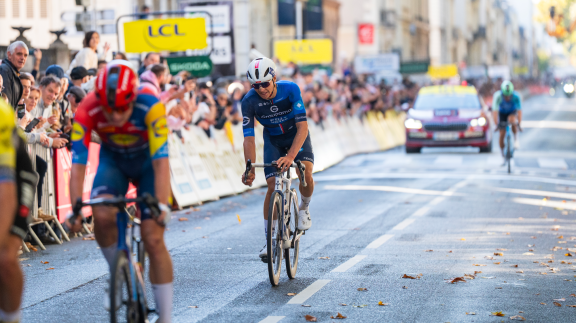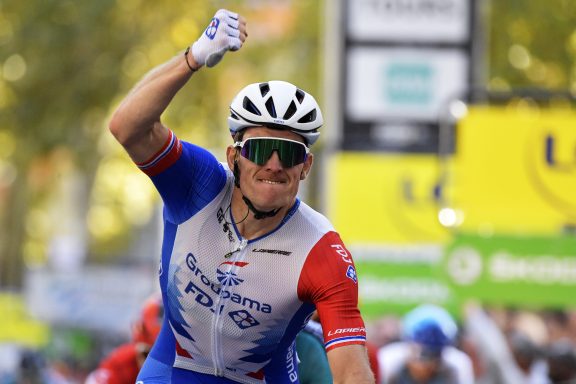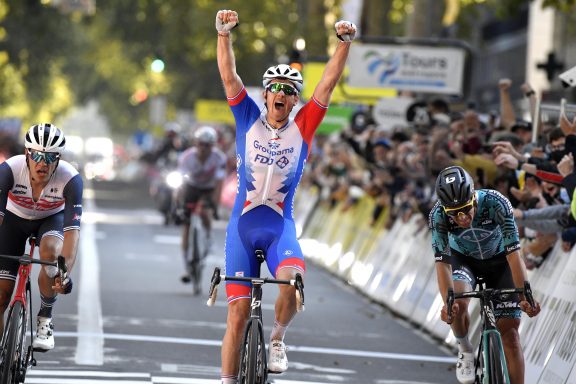

For the second year in a row, Thibaud Gruel came close to victory at Paris-Tours on Sunday. In front of his family and friends, and on roads he knows well, the local boy showed that he was one of the strongest riders in the field, making it into a six-man group that emerged at the front over the final climb of the course. However, the tactical nature of the final did not work in his favour and, after two groups came back together, he had to settle for seventh place in the sprint. Olivier Le Gac, meanwhile, took part in his last race with Groupama-FDJ United.
The 216 kilometres from Chartres to Tours were to bring the 2026 French road cycling calendar to a close on Sunday. Or at least the calendar of road races, as the official end of the season will not come until next week, with the traditional Chrono des Nations in Les Herbiers. Nevertheless, the day after Il Lombardia, a significant part of the international peloton was preparing to pin on a race number for the last time this season at the 120th edition of the French classic. Continuing the trend of recent editions and the transformation introduced in 2018, the race once again featured a particularly demanding final 70 kilometres, with ten vineyard paths and nine climbs. These obstacles were expected to provide the setting for the decisive battle, but a strong breakaway of twelve riders forced the peloton to work hard throughout the day. As the riders approached the first vineyard path, the gap stood at 1 minute 30 seconds. It then dropped to under a minute with 50 kilometres remaining, ahead of the first decisive sequence of difficulties. “When we reached the key section, everyone wanted to be near the front,” Frédéric explained. “But not everyone can be there. Things got heated, and we saw a huge crash that marred this Paris-Tours.”
“We had to make choices” – Frédéric Guesdon
Clément Russo and Olivier Le Gac were among those caught up in the crash, while Thibaud Gruel managed to avoid it by riding straight into the neighbouring field. “I got a bit scared, but I managed to avoid the crash,” said Thibaud, who dropped back into a second group. “It wasn’t pleasant having to fight my way back to the front, but fortunately Romain helped me a lot so I could make the jump across. I made a big effort at that point, but I managed to get things back on track.” Like the young local rider, the French champion also managed to bridge the gap to the leading group after a few minutes of chasing. He joined Axel Huens and Bastien Tronchon, who had escaped the consequences of the crash. The Vuelta stage winner then sacrificed his own chances for his teammates, taking the lead in the group as they chased the five remaining breakaway riders. With around 35 kilometres to go, Axel Huens also attempted to anticipate the action, but abandoned his move after a few kilometres when he saw that the peloton was still well organised. The racing did not intensify again until around ten kilometres later, on the Côte de la Rochère, where Thibaud Gruel did an excellent job of staying with the strongest riders. Axel Huens and then Romain Grégoire subsequently caught up with the group, which had been reduced to around thirty riders.
On the next climb, the early breakaway was caught, but one rider managed to escape on his own. Caught out of position, Groupama-FDJ United initially tried to send Romain Grégoire in pursuit. However, the French puncheur nearly crashed coming out of a corner. Thibaud Gruel then followed several attacks, but he couldn’t join a duo that managed to bridge across to the lone leader. “That was the only moment in the entire 216 kilometres when we came under a bit of pressure,” Frédéric explained. “We knew Thibaud was strong, that this was his race, and we had to make choices. Romain perhaps wasn’t feeling at his best, so he sacrificed himself to help bring the move back. When you have four riders, and then three, in a leading group, you have to know when to make a decision.” Thanks to the work of the French national champion, the groups came back together on the vineyard path preceding the final climb. As he’s used to, Thibaud Gruel stayed near the front throughout this crucial section, beginning the final climb in third position. He then held firm when the final attacks surged and came over the top in a group of six, with a small gap over the rest of the field. “With the headwind, things split up later than they did last year,” Thibaud observed. “We immediately started working together and taking turns on the front. It was a strong group, but riders came back from behind a little later, and from that point onwards the final became very tactical.”
“Fewer regrets than last year” – Thibaud Gruel
With five kilometres remaining, the leading group grew from six to eleven riders, which led to a moment of gambling from everyone. “It was difficult because I was on my own, and I was worried about missing the decisive move,” Thibaud said. “I followed quite a few attacks at first, but then I thought I was going to waste too much energy if I kept following everything. I saw that the two Decathlon riders were behind, so I decided to follow Lapeira’s wheel.” As the riders entered the final two kilometres, however, the breakaway group began to split slightly. Four riders gained a few metres, and Per Strand Hagenes even managed to go clear on his own under the flamme rouge. “I went all-in for the sprint, but Hagenes was strong, so it didn’t work out that way,” Thibaud admitted. “I couldn’t do everything myself anyway.” On the finishing straight, two riders crossed the line ahead of the sprint, in which the rider from Tours finished fifth, giving him seventh place overall on the day. “It was a bit like last year: you had to get the tactics right and have a bit of luck, and I was missing some of that,” he added. “I felt really good, and I was highly motivated to race at home in my final event of the season. The team helped me a lot. It was a great day, even though I’m a little disappointed with the result. That’s twice now that I’ve been in contention for the win, but I have fewer regrets than last year.”
“The feeling is mixed,” Frédéric agreed. “We can say that we’ve been beaten by stronger riders in the sprint, but the final was still very tactical, and perhaps there was a way to win. Seventh is nevertheless a good result, and Thibaud is still young. He’ll have plenty of other opportunities.” Axel Huens (15th) and Romain Grégoire (22nd) finished in a chasing group around 30 seconds behind the winner. While the 2026 edition of Paris-Tours brought the season to a close for many riders, including the French national champion, it also marked the end of a 13-year adventure between Groupama-FDJ United and Olivier Le Gac. “It’s one of the old guards who’s leaving, and that surely means something,” Frédéric said. “I saw him join the team, and I’ve always been his designated sports director. Olivier has been an example to everyone throughout this decade: a model, loyal teammate, and a true road captain for our younger riders in recent years. In his own way, he has left his mark on the team’s history.”