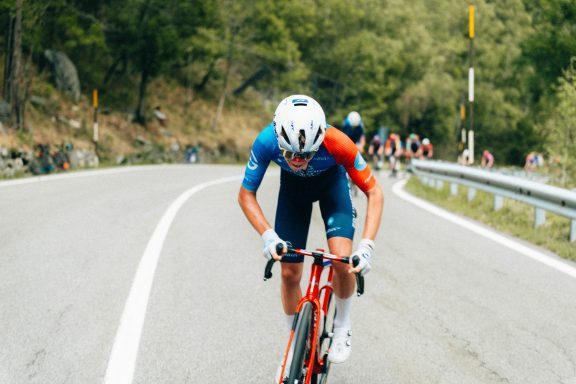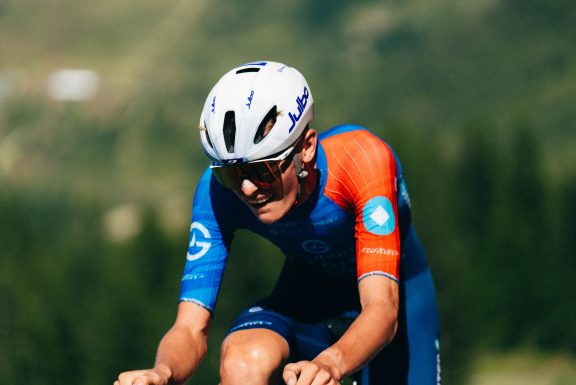

The Tour de l’Avenir underwent a major change for its 2026 edition, opening the door to development teams. Like several others, Groupama-FDJ United’s “La Conti” was therefore given the opportunity to take part in the most important event on the U23 calendar, and it made its presence felt during the first three stages through several breakaways. Although Jérôme Gannat’s riders have so far been unable to do better than the 11th place achieved by Victor Loulergue on the opening day, further opportunities, particularly in the mountains, are coming. (Photo : Tour de l’Avenir – Jolypics)
It was therefore a mixed peloton, made up of WorldTour development teams (17) and national selections (9), that lined up in Caen last Thursday for the start of the Tour de l’Avenir in its new format. Victor Loulergue, Rémi Daumas, Soan Ruesche, Johan Blanc, Reef Roberts and Yann Dubois made up the “Conti” squad, which immediately made its mark from the opening kilometres of the first stage. “A four-man breakaway went clear quite quickly, with Soan,” explained Jérôme Gannat. “They built up a lead of as much as four minutes, but in a strategic section we had identified halfway through the race, echelons began to form in the peloton. A first group of 18 riders broke away, with Victor in it, and they caught the breakaway as they entered the finishing circuit, which included a one-kilometre climb at 8%.” With 25 kilometres to go, the Côte de Crennes was tackled for the second time, and the race exploded once again. “Lorenzo Finn accelerated, and Victor managed to stay with him, along with just three other riders,” Jérôme continued. “They gained around 20 seconds on the rest of the group and managed to maintain that gap for one lap, but on the final passage, Victor couldn’t match Finn’s pace. He had already made a huge effort to stay with them on the previous climb, and I think he hadn’t fully recovered. It simply came down to the legs.”
“We were hoping for a little more” – Jérôme Gannat
The rider from “La Conti” was subsequently caught by the first chasing group, in which he went on to take 11th place on the stage, 36 seconds behind the winner. “Rémi limited the losses by finishing in a peloton of around 40 riders, about two minutes back,” Jérôme added. “We couldn’t really have expected much better. We knew it was going to be a difficult day for him in the echelons.” The wind was once again set to play a key role during Friday’s second stage, covering just 116 kilometres from Nogent-le-Rotrou to Amboise. “It was a rather unusual stage, almost completely straight, with a crosswind and a few exposed sections,” Jérôme explained. “Johan broke away with the French champion at the start and they built a small lead, but every time they reached an exposed section, the peloton would accelerate and the gap would go down drastically. Then the peloton would ease off and the breakaway would regain some ground… We knew there would be a major acceleration around the 70-kilometre mark, and this time the team was well positioned. The peloton split in two and all our riders were in the front group. They even started organizing the echelon before a major crash brought around 20 riders down.”
The race was then neutralized, with a new start given around 20 minutes later, while it was announced that the GC times would be frozen with 10 kilometres to go. “There were still around 30 kilometres to go, and some teams took control to set up a sprint finish,” Jérôme continued. In the bunch sprint, Victor Loulergue had to settle for 16th place. “We didn’t have much of an impact,” admitted his sports director. “We were hoping for a little more because Victor had produced a good sprint in Burgos, but the final was messy and he wasn’t able to sprint properly.” The young Frenchman nevertheless moved up to eighth overall at the end of the second stage. On Saturday, the third stage was not expected to shake up the hierarchy on paper, despite its daunting 230-kilometre distance. “We were expecting a lot from this stage given the distance and the accumulated fatigue,” Jérôme said. “Our main goal was to get into the breakaway. That’s what we did, but after 40 kilometres it only formed with four riders, including Victor. From that point on, we knew it was going to be difficult. The final was slightly rolling, but it was still very fast, and several teams organised themselves behind, never allowing the gap to exceed 3:30. It was mission impossible.”
“We haven’t been rewarded for our efforts” – Jérôme Gannat
Victor Loulergue nevertheless spent the entire day up the road. He first saw five chasers make contact with 60 kilometres remaining, before the entire peloton closed the gap a few minutes later. In the final, several attacks shook up the bunch, but the last attackers of the day were caught with just 300 metres to go, following a final kilometre on a false-flat uphill finish. “We were reasonably well positioned and tried to move up as a team, but in the sprint we found ourselves a little too far back,” Jérôme admitted. “It wasn’t incisive enough.” Soan Ruesche and Victor Loulergue finished 19th and 20th respectively on the stage, while the latter moved up another place in the overall standings (7th, ed.). On Sunday, one final stage without any major climbs awaits before the race becomes considerably tougher from Monday onwards. “We were expecting a lot from these first four days,” Jérôme summed up. “We wanted to be in every breakaway, which we have achieved so far. We wanted to get off to a good start and put the team on a positive trajectory. For now, we haven’t been rewarded for our efforts, with an 11th place as our best result, but that’s racing. It’s a shame, but there’s tomorrow, followed by the stages that are more suited to the climbers, particularly Rémi.”