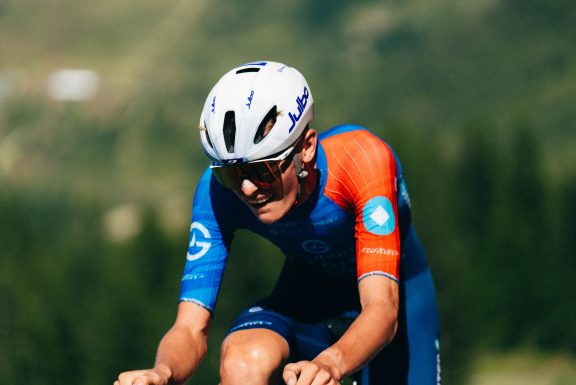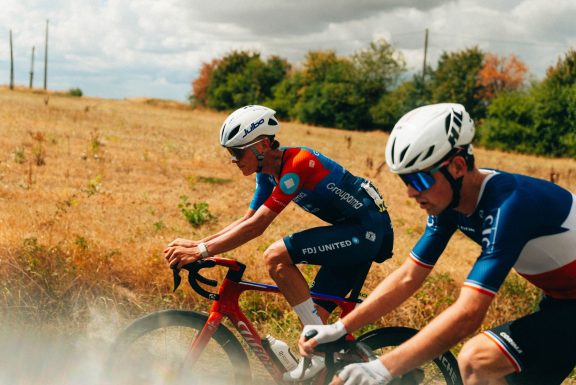


Right up until the end, Groupama-FDJ United’s “La Conti” kept fighting. Present at the front and attacking since the start of the Tour de l’Avenir, the Besançon-based team also animated the final two mountain stages on Tuesday and Wednesday. Rémi Daumas and Victor Loulergue were nevertheless not rewarded for their efforts, while the French climber was unable to battle it out with the very best. He eventually finished 17th overall, while Soan Ruesche also secured a place in the final top 20, in 19th.
The first hierarchy had already been established on Monday in the Tour de l’Avenir general classification, during the uphill time trial to Flaine. But 24 hours later, the riders faced a monstrous queen stage, featuring nearly 5,000 metres of elevation gain over barely 150 kilometres, and everything could be turned upside down. The day’s menu included the climbs of the Col des Saisies, Cormet de Roselend and the very long ascent of the Col de l’Iseran, from Bourg-Saint-Maurice via Val-d’Isère. True to its week’s racing philosophy, “La Conti” was not intimidated and immediately joined the battle. “A group got away in Megève, with Victor already in it, but there were riders who were well placed in the general classification, so the move was brought back on the Col des Saisies,” explained Jérôme Gannat. During that same climb, a group of around ten riders managed to break clear more decisively, and Rémi Daumas was among them. After a strong descent, Victor Loulergue caught up with his teammate at the front of the race a few kilometres later. Their lead grew to three minutes before they reached the Cormet de Roselend (20 km at 6%). “The cooperation was more or less working, and near the dam, Rémi attacked,” Gannat continued. “It wasn’t necessarily to launch a major offensive, but mainly to tackle the very technical descent with a bit of a gap. He went over the top with a 40-second lead, and at the bottom of the descent he was caught by three riders.”
“His pedal stroke wasn’t smooth anymore” – Jérôme Gannat
However, cooperation within the group was far from great, allowing several more chasers to bridge across. “Then, on the beautiful road towards Val-d’Isère, there was a bit of confusion and they attacked one after another,” Jérôme said. With around 30 kilometres to go, the breakaway split apart, and Rémi Daumas was unable to stay with the strongest riders in the move. He hung on for a long time in a third group on the road, but the yellow-jersey group caught him five kilometres from the summit. “He started to struggle on the climb to Val-d’Isère,” Jérôme explained. “You could tell that his pedal stroke wasn’t smooth anymore. That was confirmed on the climb to the Iseran, where he lost a few places. He was also caught by Soan in the final kilometre.” At the finish, Soan Ruesche was therefore the team’s first rider home, in 19th place, 5:02 behind the winner, while Rémi Daumas crossed the line in 21st. “It was a good breakaway because the top three riders on the stage came from it, but physically it took its toll, and Rémi was suffering during the final hour,” Jérôme concluded. “Perhaps his attack on the Cormet de Roselend wasn’t necessary, but I don’t think it fundamentally changed the outcome. The team’s performance was good: we were still represented in the breakaway”.
Going into the final stage, two “La Conti” riders were therefore inside the top 20 overall. There was still a long 30-kilometre climb to Lago Serrù to tackle on Wednesday, including a final five-kilometre section averaging nearly 9%. “The start of the race was very flat and very fast, then, once we reached more undulating terrain, a four-man breakaway went clear with Victor in it again,” Jérôme recounted. “The peloton eased off a little, the breakaway gained two minutes, and then Lorenzo Finn’s yellow-jersey train started rolling.” The breakaway eventually fell apart after covering nearly a third of the final climb, and Victor Loulergue was caught by a drastically reduced peloton around 13 kilometres from the finish. Still well placed at that point, Rémi Daumas then made his presence felt with two brief accelerations. “It was quite well timed because it was a moment when the pace had eased, and it could have allowed him to gain a small advantage,” Jérôme added. “Unfortunately, his legs didn’t respond as he would have liked. Unlike yesterday, the aim was for him to test himself against the best, but in the end, the result was broadly the same.”
“We played an active role in the race” – Jérôme Gannat
At the summit, Rémi Daumas crossed the finish line in 21st place, three minutes behind winner Lorenzo Finn. “That was more or less where he belonged in this Tour de l’Avenir given his current condition,” Jérôme said. Rémi Daumas ultimately finished 17th overall, two places ahead of his teammate Soan Ruesche in the final standings. “In terms of results, we fell short of our objectives,” the team’s sporting director summed up. “We had set ourselves the goal of a top-10 overall finish with Rémi and a stage victory. We fell somewhat short of that, but in terms of our approach and attitude, we don’t have much to reproach ourselves for. We gave ourselves the means to achieve results, but we weren’t rewarded for our efforts. We really wanted to race aggressively because we knew that was our best chance of getting a result. And we were present in every breakaway, so in that respect we did very well. The commitment of all the riders was remarkable. We were simply one step behind the very best riders, rather than being up there with them. We tried hard to shake things up, but the level was very high and we couldn’t turn our efforts into a major performance. Nevertheless, we played an active role in the race, and that is also what we want for the development of our young riders. We were missing a little bit of physical strength and a little bit of luck. This first Tour de l’Avenir was nevertheless a valuable learning experience and has shown us how much work remains to be done to get closer to the very best.”