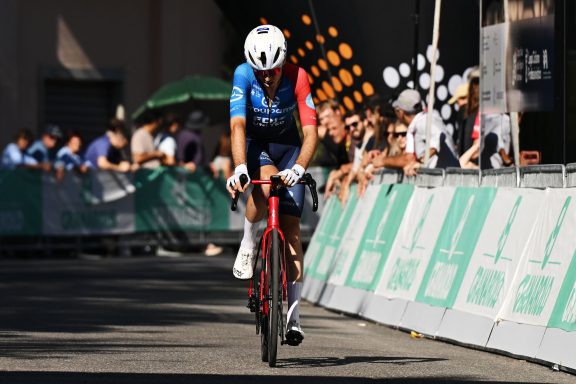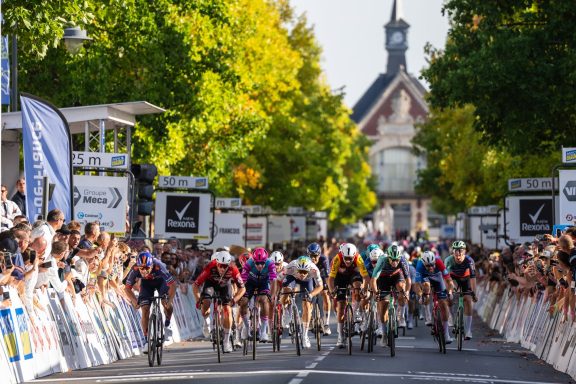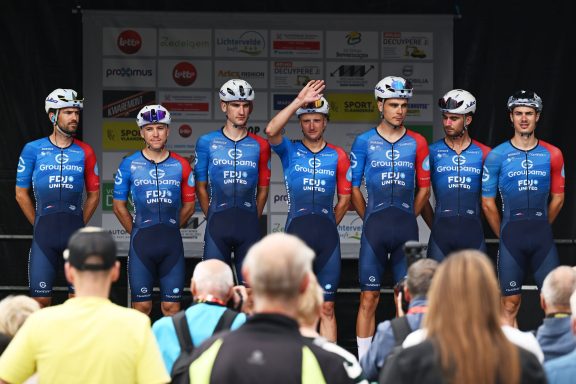

As in its recent races, the Groupama-FDJ United cycling team went for a highly aggressive strategy on Monday at the Coppa Bernocchi. With fifty kilometres remaining, Lorenzo Germani and Brieuc Rolland joined a breakaway group in the hope of beating the peloton. After spending almost an hour up the road, however, the duo’s adventure came to an end with seven kilometres to go, and the sprint then did not go Bastien Tronchon’s way (21st). The team’s next Italian challenge comes on Tuesday with the Tre Valli Varesine.
Two days after the Giro dell’Emilia and on the eve of the Tre Valli Varesine – two races that are more suited to puncheurs and climbers – Groupama-FDJ United’s Italian campaign moved on Monday to the Coppa Bernocchi, a more open race on paper. Around ten climbs were certainly spread across the day’s 180 kilometres, but the final one came more than thirty kilometres from the finish. “This race can sometimes be decided in a sprint, and sometimes from a breakaway,” explained Benoît Vaugrenard. By a breakaway, he was referring to a group of attackers formed on the Piccolo Stelvio circuit (1.6 km at 7%), which had to be covered seven times between the two flat sections from Legnano, the start and finish town. “We had Bastien for the sprint, but there were riders on the start list who were faster than him,” Benoît continued. “So the idea was to make an aggressive race on the circuit. We had riders capable of doing that, with Valentin, Rudy, Brieuc and Lorenzo, and we also know that Bastien likes difficult races.” So, when the fight began in the peloton with sixty kilometres to go, behind a four-man break, Groupama-FDJ United was very proactive. The team was initially represented by four riders in a small group that broke away from the peloton, and then willingly joined the various attacks.
“We’re not here just to animate the race, but to get results” – Benoît Vaugrenard
When Jhonatan Narváez made his clear move with 48 kilometres remaining, Brieuc Rolland did a superb job of bridging across to the Ecuadorian alongside Neilson Powless. Lorenzo Germani then joined his teammate with Florian Stork a little further down the road. “They played it very well,” Benoît said. “We wanted an aggressive race, so having two riders in a group of five was perfect.” The counter-attack quickly gained thirty seconds on the peloton, but it also soon found itself with a real issue. “Unfortunately, Powless wasn’t pulling at all,” Benoît said. “The others were working well together, but he was definitely slowing this group down. On top of that, there were still a lot of teams riding for the sprint, and the headwind on the run into Legnano in the final did not help the breakaway either.” After the final ascent of the Piccolo Stelvio, the chasing group was only one minute behind the early breakaway, while the peloton was thirty seconds further back. Lorenzo Germani, Brieuc Rolland and their breakaway companions then put up an excellent fight over the final thirty kilometres, even closing to within thirty seconds of the early break with ten kilometres to go. However, the alliances between the sprinters’ teams ultimately brought their efforts to an end.
With seven kilometres remaining, their adventure was over. The early breakaway surrendered shortly afterwards, and the race did conclude in a sprint. Too far back from the front of the pack with 500 metres to go, Bastien Tronchon was unable to contest the sprint, finishing 21st. “He was missing a little bit of legs for his return to racing after the Vuelta, and that affected his positioning at the decisive moment,” Benoît explained. “We rode a very good race as a team, the group’s form was excellent, but we didn’t get anything out of it in the end, and that’s what’s disappointing. We didn’t come here for 21st place. That’s inevitably the negative of the day, because we’re not here just to animate the race but to get results, and everything had been perfect right up until the sprint. It’s a shame because the group is doing well, but now we need to find that opening, starting tomorrow at the Tre Valli Varesine. I’m convinced we have what it takes. We just need to finish the job.”