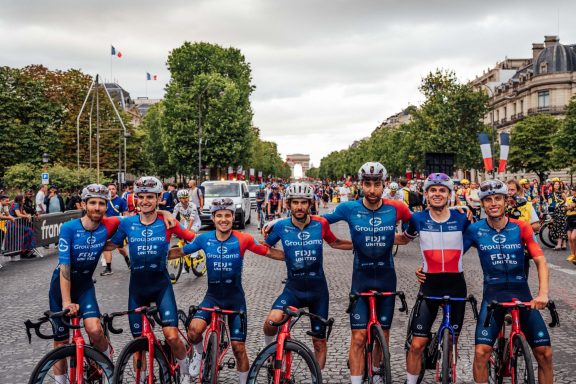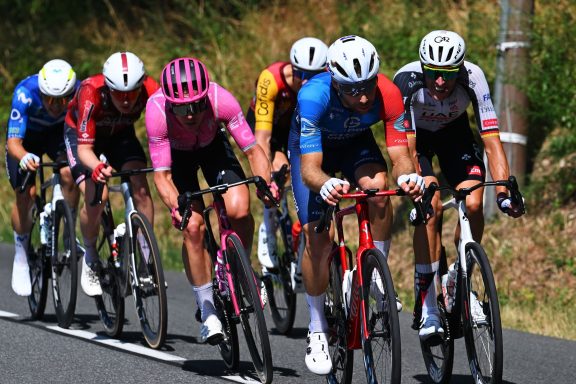

The second week of the Tour de France got off to a flying start at the beginning of the week. Following an explosive Bastille Day stage, featuring a demanding route to Le Lioran where the breakaway of Romain Grégoire, Guillaume Martin-Guyonnet and Clément Braz Afonso was ultimately unable to contend for victory, the peloton covered the fastest stage in the history of the race on Wednesday. On the road to Nevers, the riders averaged nearly 51 km/h, and Clément Russo once again managed to finish inside the top ten in the bunch sprint (8th).
After the first rest day, the riders tackled quite a demanding Stage 10 through the Massif Central on Tuesday. Heading towards Le Lioran, a finish city back in 2024, they faced seven classified climbs and close to 4,000 metres of total elevation gain. It was always going to be a race of attrition, although the outcome remained highly uncertain as the peloton rolled out from Aurillac. Many riders were hoping a breakaway would succeed, and Groupama-FDJ United was fully committed to making that happen. While the peloton refused to allow any attacks to stick before the intermediate sprint, the real battle began immediately afterwards. Ewen Costiou and Romain Grégoire were involved in the opening moves, but after around 50 kilometres of relentless racing it was ultimately Clément Braz Afonso and Guillaume Martin-Guyonnet who made it into a breakaway of around twenty riders. Shortly afterwards, their French national champion teammate bridged across to join them. “The guys once again did a fantastic job, but UAE decided not to let the break go,” regretted Yvon Caër. “Once they started putting pressure, we were just lacking a bit of strength. Guillaume had a difficult time because of breathing issues. The positive takeaway is that Romain is back to his best and really wanted to race aggressively. The team executed the plan very well, and hopefully we’ll keep working in that direction so we’re in the right place when a breakaway finally gets the chance to fight for the win.”
“We have to appreciate this result” – Yvon Caër
One survivor from the break managed to stay clear for almost another hour, but it was ultimately the overall favourites who battled it out on the final climbs, with Tadej Pogačar adding yet another stage victory to his tally. On Wednesday, the peloton returned to much flatter roads for the 161-kilometre stage between Vichy and Nevers, which was completed at a record-breaking pace. “Everything came together: a strong tailwind and high speeds all day long,” explained Yvon. “The peloton didn’t want to give the breakaway much of an advantage, so the pace was extremely high throughout the stage,” added Clément Russo. The riders eventually completed the stage at an average speed of 50.91 km/h, making it the fastest stage in Tour de France history. It was won by sprinter Søren Wærenskjold, while Clément Russo once again fought his way into the top ten thanks to another well-timed finish. “It was actually quite difficult because the speed wasn’t as high as it had been in Bergerac,” he explained. “Once we caught the breakaway, the peloton eased off a little and spread across the whole road, which made it hard to move up. When things accelerated again with 1.5 kilometres to go, the bunch stretched out and I found myself a bit too far back. In the sprint itself, though, I managed to come back from behind, find my way through, and finish eighth once again. It’s another top-ten finish, and I’m happy with that.”
“Clément made the right decisions,” added Yvon. “He gave himself a bit of space so he could choose the best line. When things became a bit messy on the left-hand side, he moved to the right and finished with a lot of speed. We have to appreciate this result, and it shows that Clément is genuinely capable of fighting for a really big result in this Tour.” The rider from Lyon could have another opportunity as early as Thursday on the way to Chalon-sur-Saône, in a stage with a less predictable outcome. “There could be an opening for attackers early on,” concluded Yvon. “Will the sprint teams be able to control a breakaway of seven or eight riders? That’s far from certain. The final part of the stage is also a bit rolling, so we could see a more animated race. We’ll need to stay alert from the start and be ready for every acceleration during the final hour.”