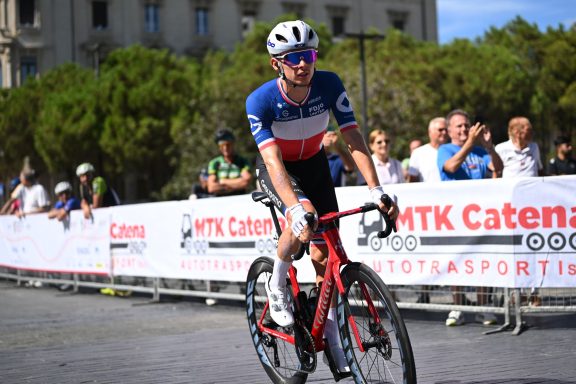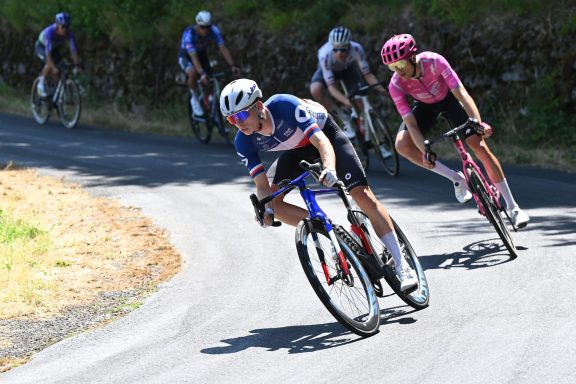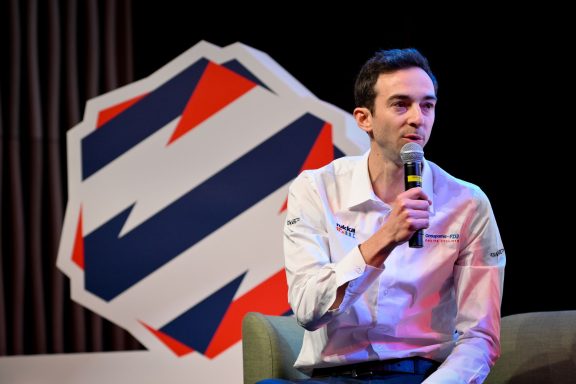

Romain Grégoire came within just a few metres of claiming his first victory in the French national champion’s jersey. This Wednesday, the young puncheur genuinely believed he was going to win the Grand Prix de Wallonie after a remarkable effort from his teammates and a sharp attack of his own two kilometres from the finish on the Citadel of Namur. However, he was forced to concede victory in the closing metres to Aubin Sparfel, who came back from behind. A frustrating outcome.
Eight years later, the WorldTour Groupama-FDJ United team returned to the Grand Prix de Wallonie this Wednesday. With the French champion in their ranks, there was never any question of simply making up the numbers. “It was Romain’s first time racing this event, but we knew that the final climb of the Citadel of Namur really suited his qualities, given its length, the corners and the fatigue accumulated during the race,” explained William Green. “Knowing all that, we knew we had a card to play. He was good in Italy, not great after the crash, but he had recovered well and we knew we had a true opportunity today. That’s why we took control of the race from the very beginning.” Six riders animated the first part of the race, but it was also a matter of managing the chase smartly. “We wanted to allow the breakaway to build a fairly substantial gap so that we could set a strong pace in the middle of the race,” William explained. “We stopped riding once the gap dropped below three minutes because that risked encouraging attacks midway through the race. We then took control again with Baptiste, who did an incredible job today. As expected, there were still attacks on the first two climbs. A group of strong riders got away, but we stayed calm. The group wasn’t that big, and we knew there would then be headwinds and crosswinds. Esteban did a really great job, and then other teams came to ride with him.”
“I’m really proud of the team” – William Green
With forty kilometres to go, the chasing group caught the morning breakaway, but the peloton was only about a minute behind. Thanks to a well-organised chase within the bunch, all the attackers were caught with eighteen kilometres remaining, at the foot of the penultimate climb, Tienne aux Pierres (3 km at 5%). “We knew attacks could come, but if they didn’t, the objective was to set a strong pace so that we could find ourselves more easily on the final climb,” William continued. “Decathlon-CMA CGM set a very hard tempo, and then Lorenzo was very strong when he took over in the second half of the climb. Thanks to his efforts, riders such as Girmay and Askey were dropped and couldn’t get back. It was a real team effort.” Although Tim Wellens and a few others tried to get away at the top of Tienne aux Pierres, Axel Huens remained alert to close a few gaps before Lorenzo Germani took over at the front again. “He started riding early because we didn’t want the group behind to come back,” William explained. “He was able to lead the group from six to three kilometres from the finish, right to the foot of the climb. We tackled it in first position, then Axel did exactly the strategy we had planned: eliminate as many riders as possible and make the climb as hard as possible. It was really important to make that effort to give Romain the best possible chance.”
For more than a kilometre, Axel Huens therefore controlled the front of the peloton and stretched the group out, with his French champion teammate in his wheel. “The team once again did a monstrous job,” Romain said. “Axel did a superb final climb after Lorenzo dropped him off at the foot. It was exactly the plan from this morning’s briefing. He launched exactly where I wanted him to, so that I could start my attack, and then I did exactly what I had to do to eliminate the fastest riders.” “Everything went exactly as planned,” William added. “We knew it would be difficult with the headwind in the final kilometre, but we had to make that effort, and we did it where we wanted to. I’m really proud of the team for executing exactly the plan.” The French champion duly launched his attack two kilometres from the finish, coming out of a corner, and took only two riders with him. One of them was Paul Lapeira, whose counterattack failed to shake off Romain Grégoire, but which reduced the trio to a duo with 1,500 metres remaining. From then on, the two riders worked together without overcommitting, while around half a dozen riders chased behind them. “It was normal to gamble a bit with Lapeira,” Romain admitted. “That’s what happens when there are two riders in the final of a bike race. I don’t think I made any mistakes.”
“I’m very disappointed” – Romain Grégoire
Under the flamme rouge, the duo still held an advantage of around thirty metres, but as the chasers closed in, the sprint opened with nearly 400 metres remaining for Romain Grégoire and his opponent. The rider from Besançon managed to get the better of his rival with 200 metres to go and entered the final straight in the lead. However, Aubin Sparfel came back to him with 50 metres remaining, leading to a side-by-side battle all the way to the line. The duel ultimately went against the French champion by the narrowest of margins. “I think I did everything right,” said Romain. “We simply came up against a very strong Aubin Sparfel, who took the victory away from me in the final 50 metres. It’s extremely frustrating because I could see the victory so close, but it didn’t happen. I’m very disappointed.” “The disappointment is huge, perhaps more than usual, because we feel that we gave everything we had,” William continued. “But with hindsight, we wouldn’t change anything about our strategy. We simply have to acknowledge Sparfel’s impressive effort. It’s a shame because Romain is getting closer and closer, and the team was once again there around him today. We’ll try again.”