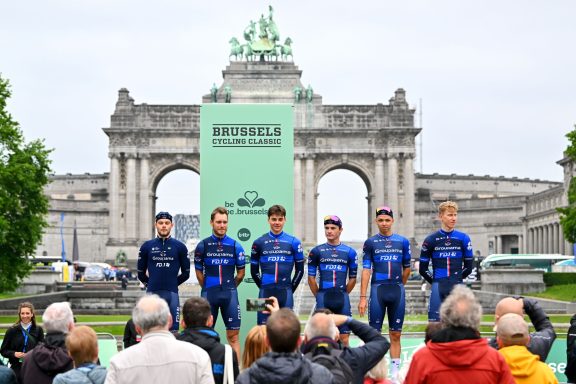

The three ascents of the Muur van Geraardsbergen and Bosberg were not enough to prevent a reduced bunch sprint at the Brussels Cycling Classic on Sunday. After Titouan Fontaine’s strong breakaway ride earlier in the day, Groupama-FDJ United Cycling Team turned its focus to Paul Penhoët for the final. The Frenchman eventually finished tenth despite having to launch his sprint from quite far back. Next up: the Circuit Franco-Belge.
Two months after the end of the Classics campaign, the riders were back in the atmosphere of the Flemish races on Sunday. For the 106th edition of the Brussels Cycling Classic, the peloton was set to ride across several iconic spots, most notably the Muur van Geraardsbergen and Bosberg sequence, which had to be tackled three times between kilometres 90 and 153. Introduced last year, the triple passage was made to animate the race final. Titouan Fontaine did not wait until the closing stages to make his mark though. After nearly an hour of battling from the start, the young Frenchman managed to join the breakaway. “The plan was to have a rider up the road, with the idea that we could get him back if a group of strong riders went clear in the final,” explained Tanguy Turgis. “Instead of giving Titouan his usual role, I decided to give him an opportunity. He put in a huge effort to make the break. He first spent almost ten kilometres alone ahead of the peloton, got caught, but managed to go clear again. He was having a really good day.” That proved to be the case throughout the race, as Fontaine came over all three ascents of the Muur van Geraardsbergen at the front alongside his four, then three, fellow escapees. Only on the final passage of the Bosberg was he finally dropped. “He needs this kind of day for his development, and everything went really well,” added Turgis.
“We were hoping for a harder race” – Tanguy Turgis
Shortly afterwards, the former « La Conti » rider was caught by a first peloton that had been thinned out on the final ascent of the Muur van Geraardsbergen, with Paul Penhoët and Axel Huens still present. “The race was less selective than expected and less selective than we had hoped,” said Tanguy. “Of course, we had the sprint option with Paul, but our ideal scenario was a strong breakaway with riders like Johan and Axel. The idea was first to follow the moves and then be proactive in the transitions. Unfortunately, we were unlucky on the final lap because Johan suffered a mechanical issue at the foot of the last Muur and we lost him there. Axel and Paul were at the front and rejoined Titouan, but Paul had to remain conservative. Axel attacked on the Congoberg, the final climb of the circuit, because he was feeling good, but two or three teams controlled things for the sprint. The race was not as demanding as we would have liked.” After around ten kilometres of chasing, a larger second peloton bridged across to the front group. As a result, nearly 90 riders headed towards Brussels for the final forty kilometres.
Although several attacks were launched in the closing kilometres in an attempt to avoid a sprint finish, none succeeded, and a reduced bunch finish began to take shape. “Since the circuits were a bit less difficult than last year, there were more teammates left to support the sprinters,” said Tanguy. “On our side, we only had Olivier and Axel left for Paul. The idea was for Axel to lead Paul out while also doing his own sprint because the finish was really demanding. With 800 metres to go, Axel was in a good position among the favourites, but another rider came between them and Paul lost contact. It’s a shame because Paul had to start his sprint from behind. He came back very fast in the final metres, but not being in Axel’s wheel, he couldn’t launch his sprint properly.” Despite a strong comeback, Paul Penhoët had to settle for tenth place. Axel Huens crossed the line in fifteenth, while Jordi Meeus claimed victory. “We have a few regrets,” concluded Tanguy. “For sure, we were hoping for a better result in the sprint, but we were also hoping for a harder race that would have suited Axel and Johan, who both seemed to be having a very good day.”