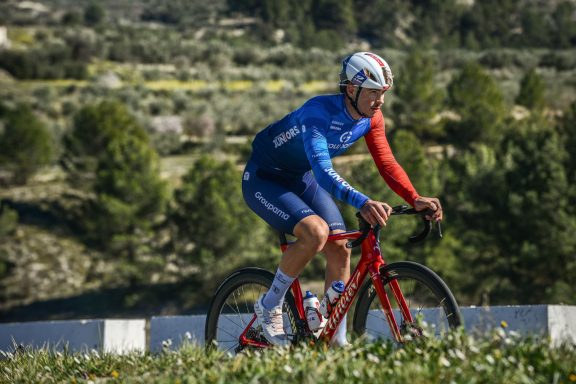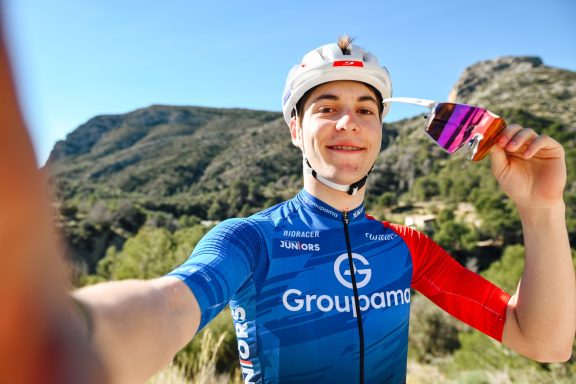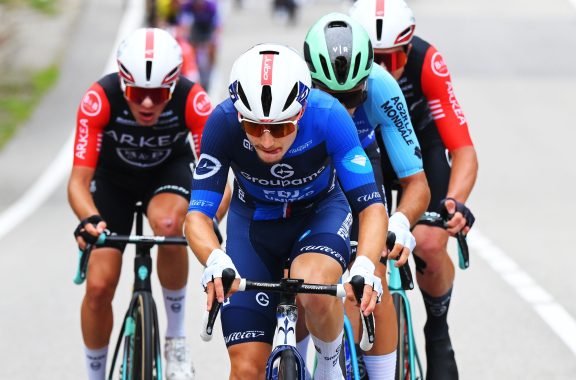

Having come through “La Conti,” with which he won the U23 Il Lombardia, Brieuc Rolland is currently riding his second season with the WorldTour team Groupama-FDJ United. At just 22 years old, the Frenchman has already claimed two stage podiums at the Vuelta, yet he continues to explore every avenue for performance. For several months now, he has been working alongside Marie-Laure Brunet, a two-time Olympic biathlon medallist who now specializes in mental coaching and has collaborated with the team since 2019. Together, they agreed to give us an inside look at this invisible preparation, which has become a key factor at the highest level of sport.
Brieuc, Marie-Laure: is a rider who feels good mentally necessarily more performant?
Brieuc: Absolutely. Cycling is such a demanding sport that you need to be at 100% physically and mentally to perform. If the body is there but the mind isn’t, it’s really not ideal. For me, the two go hand in hand. I’d even say the mental side is more important than the physical side. When you feel mentally strong and psychologically solid, you’re able to push beyond your limits and get through difficult moments. Every rider will tell you that the body says stop pretty quickly, especially when you’re not the strongest. That’s where mental preparation and mental strength come into play. If you only listen to the body, you stop very fast. It’s an omnipresent aspect of our sport.
Marie-Laure: A rider can still perform even when they’re unhappy or mentally struggling. I can think of many athletes who achieved incredible performances while being miserable or in almost pathological states. However, the kind of mental coaching I believe in aims to create sustainable and ethical performance. I think an athlete who has a better understanding of who he is and what he needs will manage himself better and be able to produce consistent performances over time. Every athlete obviously wants to perform, but also to last. The idea is to go beyond the “one-shot” performance, which is much more accessible to a larger number of people.
“The goal is to put things in place when they’re going well” – Marie-Laure Brunet
Are there specific aspects to consider when supporting cyclists mentally?
Marie-Laure: Of course. The first is managing an individual sport with a strong collective dimension. For example, Brieuc is sometimes in a domestique role, and other times he rides for himself. You don’t approach a race the same way depending on the role. A race also lasts several hours, and during that time you can go through many emotional and physical states. If you don’t work on that or learn how to deal with it, the easy option is to sit up when things get hard. I sometimes say that human nature tends to be a bit lazy. The challenge is learning how to get through the moment when everything pushes you to do less, even though that’s precisely when you need to resist and keep fighting. The riders who handle it best are those who can manage and overcome uncomfortable or even extremely painful states. Rider profiles also matter in this kind of coaching. A sprinter, a puncheur, or a climber won’t work on the same mental aspects, because the race finales and the stakes are different.
How is your work organized over the course of a season?
Brieuc: I meet with Marie-Laure regularly throughout the year. I saw her a lot last season in particular because we put several things in place: sleep routines, stretching, and all the off-bike details. Because racing isn’t everything. We work on many aspects of daily life, and it’s been a huge plus for me. We check in regularly, so not necessarily right before a target race. We spoke before the Giro, but mostly about the last few weeks of training, especially since I hadn’t raced since the Tour of Catalonia.
Marie-Laure: It’s important to specify that mental coaching within the team is offered on a voluntary basis. For context, this year twenty-two riders expressed the desire to be supported. Brieuc and I started working together last year during his first WorldTour season, and I always find it interesting to tackle these topics early because it helps lay strong foundations for the future. Generally, I see the riders every three to four weeks, then it varies once the season gets underway. Another cycling-specific factor is that the season is long, with periods when riders are completely immersed in racing and others that are more relaxed. We schedule regular meetings to stay in a working routine. The goal is to put things in place when they’re doing well, not only when riders contact me because something is wrong.
Brieuc: Personally, I don’t really dramatize after a poor performance or call Marie-Laure saying, “It’s a disaster, nothing is going right.” I can now take a step back. I know I’ll see her a week or two later. I have time to do my own analysis and come with something constructive to say. If I just say anything in the heat of the moment, it’s not very useful.
Marie-Laure: Those situations rarely happen within the team, and I myself want the riders to be autonomous. The framework I set is that they shouldn’t call for every little thing, because the goal is also for them to learn how to find their own mental resources. However, they know that if there’s a real need, I’m always reachable, and there have been a few urgent cases. Sometimes the rider simply needs to talk and be reassured. It’s completely normal to go through hard times, and those moments shouldn’t be feared or avoided because they are an integral part of a season. These states are often linked to hormonal and physiological upheavals because what they experience is so intense and extreme. Fortunately, within the team, there is real support happening behind the scenes to make sure everyone has what they need.
“I imagine checkpoints during the race” – Brieuc Rolland
What is the foundation of the work you do together?
Marie-Laure: Mental coaching is a global and systemic form of support. We start with a broad approach focused on the person, then progressively narrow things down. I want to make sure the rider puts all the right elements in place to create a context for performance. And because they implement those things daily, they arrive at races confident that the work has been done properly. That plays a huge role in approaching competition in the right mindset. In that perspective, I work notably with neurolinguistic programming and questioning techniques. These methods allow riders to find their own answers. Sometimes I consciously shift my posture and offer advice based on my own experience and passion for performance, but most of the time it’s the questioning that guides them toward an answer. It also has much more impact, and they’re more likely to apply it if it comes from them.
Brieuc: Working with Marie-Laure has brought me more discipline and professionalism in everyday life. At the beginning, she would remind me how important it was to go to bed early, stretch, and do core work. If I hung up saying I would implement those things, then I had to do them. Otherwise, I was wasting her time, and it wouldn’t help me either. As for training, in the past, if a ride didn’t go as planned, it felt like everything was collapsing. Talking with Marie-Laure, who has been through all kinds of ups and downs in her career, helped me gain perspective, believe in myself, and trust the process. Now I have this little voice in my head saying: “It’ll come back, everything didn’t disappear overnight.” You just have to be patient, and that’s what allows you to feel good mentally.
Marie-Laure: What Brieuc is saying may sound obvious, and someone from the outside might think: “All elite athletes do the job.” The reality is no. (Brieuc nods in agreement). Take sleep for example: with screens and social media, it’s obvious that a huge part of performance is determined there. If you’re not already doing what’s necessary on that front, there’s no point talking about the rest. My goal is to help the rider define their daily strategy step by step, and to be capable of maintaining it over time. This year, the sessions with Brieuc are shorter because he has already built all the foundations. At first, I commit them to the process, they commit themselves, and because positive things start happening, it creates motivation and a virtuous dynamic. That’s what then allows us to move on to race-specific topics: handling a final, fighting for position, descending. We discuss many different themes, but the foundations are extremely important at the highest level.
How does mental coaching translate into racing itself?
Brieuc: For me, it’s very much about knowing the course. Marie-Laure and I worked a lot on that. Sometimes I used to give up a bit too early. Now it helps me enormously to know what’s coming and where I’m putting my wheels. During the Vuelta in particular, it really pushed me because I sometimes felt like I knew the final metres of certain climbs by heart. It even became part of my pacing strategy. In that respect, mental coaching helped me a lot and explains some changes in how I perceive effort. I also imagine checkpoints during the race: point A, point B, point C. I break the stage into segments, create mini-finish lines, and fight to get to the next point. Sometimes starts can feel extremely painful. You feel like everything is going wrong, and then little by little the body wakes up and you can feel much better after a few hard efforts.
Marie-Laure: I don’t really practice visualization or mental imagery, but by encouraging riders to focus on recognizing the course, they are already unconsciously engaging in imagery because they project themselves into the situation. A rider who knows the course well will inevitably manage the race differently from someone with only a vague idea of what lies ahead.
Brieuc: And besides, maybe it sounds a bit strange, but it keeps your mind occupied in the moment. You’re not solely focused on physical pain. Thinking a little about what’s coming next probably helps you think less about the burning in your legs. Keeping your mind busy when the pain is there isn’t a bad thing.
Marie-Laure: The challenge is to stay focused on what they have to do rather than paying attention to intrusive thoughts that create distraction. Because if you’re distracted by the wrong things, you feed negative self-talk and become passive. What Brieuc says is important. Breaking the effort into segments is really key because it allows you to move from one point to another without being crushed by the pressure. One day, a rider told me during a race that he was thinking he urgently needed to book an appointment with me because he felt mentally weak. Yet he ended up winning the race. That illustrates how all of this can happen during a single race day, and we work a lot on not becoming too attached to feelings. They’re useful indicators in training to manage workload, but in races, they matter far less. You need to stay grounded in action and concrete tasks. Riders have resources within themselves, and sometimes you have to work to learn how to access them.
“We genuinely take care of the riders” – Marie-Laure Brunet
So there’s no miracle trick…
Marie-Laure: “Doing the job” has never guaranteed performance, but it’s a prerequisite for it. A rider who has done everything properly knows they have the condition to perform, but they still have to make it happen on the road. Again, we start broad and narrow things down like a funnel. We create the context first, then focus on performance and race execution, but no two riders follow the exact same coaching process. Everyone has their own response. For example, if Brieuc has good legs in a race, the rest isn’t even an issue. He’ll know how to capitalize on it. On the other hand, I’ve seen riders fight all day to be in the right position at the right moment, but once they achieved it, it was as if the race was over… For some riders, there’s a blockage even when they’re feeling good, and that’s what we need to work on.
Is it important to talk openly about mental coaching?
Brieuc: It’s funny because the first time I was asked whether I wanted to see a mental coach, I said no. For me, everything was going well in my life, I didn’t have any particular problem, and I didn’t especially need it. They told me: “Try it, you’ll see.” I went, and I absolutely don’t regret it, because in reality you don’t only see Marie-Laure when things are going badly. Quite the opposite. She has a lot to bring to our lives as athletes. If I hadn’t met her, maybe I wouldn’t have performed the way I have. And all of this happened almost without me realizing it. It’s like I wasn’t even aware of it… It’s a huge advantage, on the same level as training, nutrition, and sleep.
Marie-Laure: “You don’t need to need it in order to try it”: that’s exactly my motto. I do this job because I lacked that support when I was an athlete, and because you don’t need to be struggling to benefit from mental coaching. I believe it accelerates the path to performance. There are many entry points, and you just have to seize them. We talk about it more and more nowadays, although I still sense some hesitation among athletes to discuss it openly, but that depends on each individual. They’re so immersed in what they do that they sometimes don’t realize how useful it really is. By talking about it, as Brieuc is doing today, they sometimes make the connection.
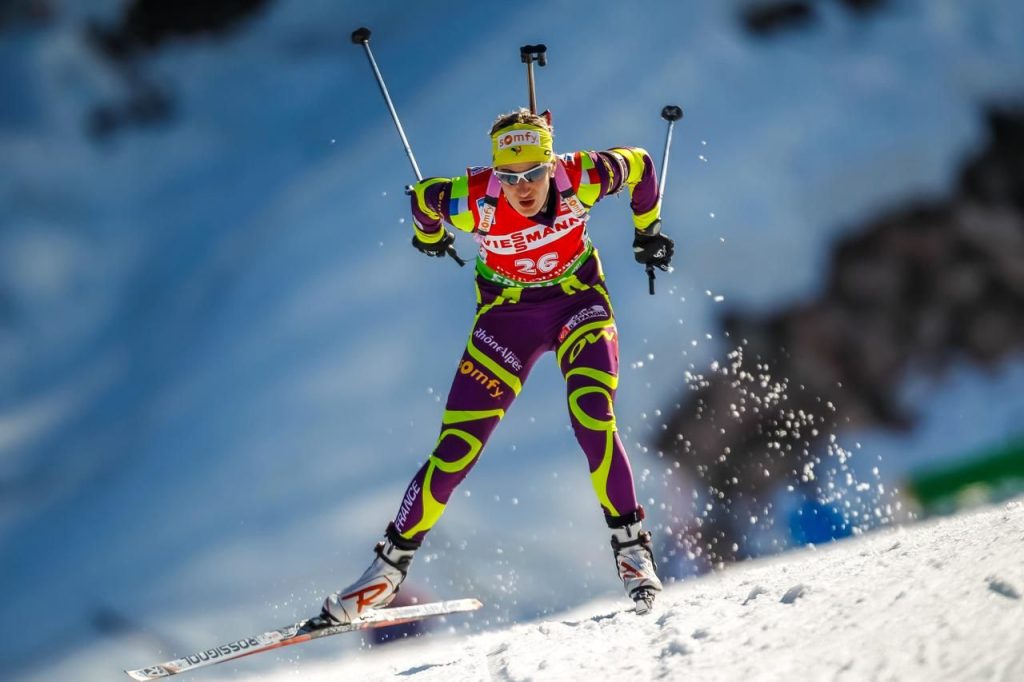
What’s especially interesting is seeing that when I first started collaborating with the team in 2019, I maybe had five riders. This year, I’m working with more than two-thirds of the roster. That shows things are evolving and riders recognize that it’s a real factor for well-being, and therefore for performance. It also shows that we care about the riders and genuinely look after them. Truly. And the team should be proud of that.
Is there a specific way to mentally prepare for a Grand Tour like the Giro?
Marie-Laure: During a Grand Tour, it’s essential to stick with what works. I tell them: do what you know how to do, no more and no less. We don’t go in holding back, but we don’t overdo it either. The main point of attention is obviously recovery because every little gain over three weeks makes a real difference at the end. Communication and relationships with the riders and staff are also important, but within the team we’re fortunate that the groups live well together, and that’s a huge plus over three weeks. However, I now warn riders doing their first Grand Tour that when they return home, there may be a small period of feeling low. It’s something people don’t talk about much, but it’s normal and physiological.
Brieuc: A Grand Tour is obviously special because it lasts 21 days, but I don’t feel like I completely revolutionize my mental preparation. You simply have to maintain the same standards for recovery and off-bike habits for a longer period. I also know there will be bad days, but what comforts me when things are hard is knowing that as soon as I get back on the bus, we’ll laugh and joke around with the guys. That does me good. I also see a Grand Tour as twenty-one one-day races. My goal is to win a stage, and when I start a stage I’ve targeted, I can’t think about the 10 or 15 stages still ahead. My race is full gas all the way to the line. If I start calculating, I can’t win, because you need to be 100% committed. Last year, the Vuelta also acted as a turning point after a start to the season where I learned a lot of hard lessons. I realized that victory was something accessible, and that with professionalism and hard work, it would eventually come. I believe in myself, I believe in the team, I believe in what I’m doing, and I do it wholeheartedly, so there’s no reason it won’t work. You have to believe in yourself, otherwise there’s no point even showing up.