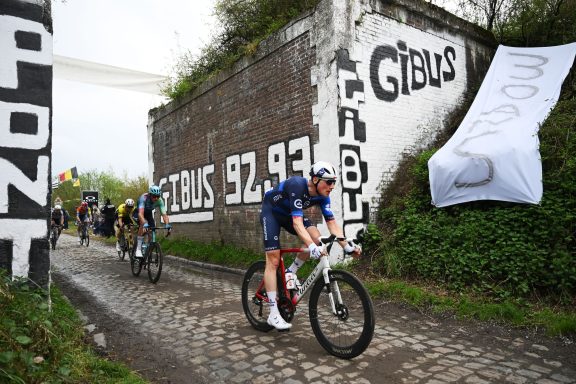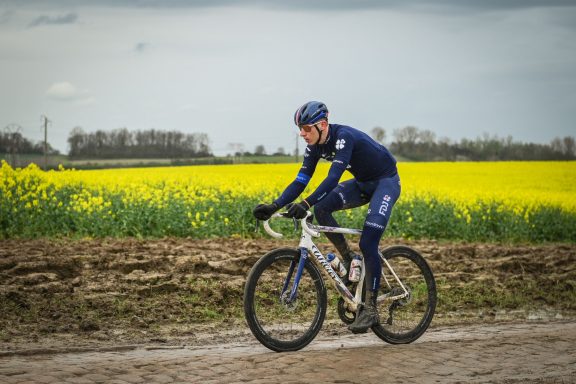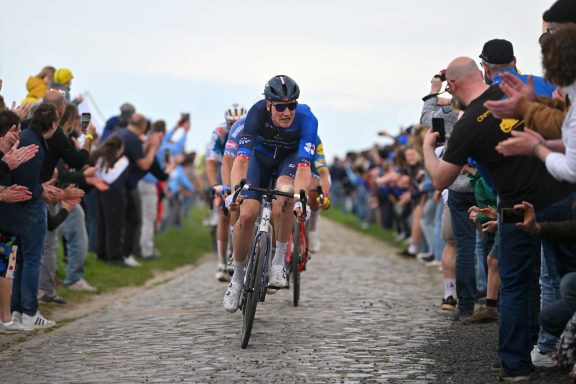

Paris–Roubaix once again lived up to its reputation. From Compiègne to the famous velodrome, the riders’ route this Sunday was strewn with numerous obstacles. In addition to the thirty sectors and fifty-five kilometres of cobblestones, mechanical issues also played a major role, and the Groupama-FDJ United cycling team was among those affected. Slowed by various incidents, Axel Huens and Thibaud Gruel were unable to fully demonstrate their abilities, and in the end Clément Russo was the first to finish “The Hell of the North,” in 23rd position.
The golden period of the cobbled Classics therefore came to an end this Sunday with the “Queen” of them all. The highlight, perhaps the pinnacle, of the early season for the specialists, the 123rd edition of Paris–Roubaix once again offered an extremely demanding course to the riders: more than 258 kilometres, including fifty-five over the dreadful northern cobbles, all located in the second half of the race. At the start in Compiègne, most teams had the same idea in mind: anticipate the major battle expected between the favorites. That is precisely why no group managed to break away during the first two hours of racing, which were covered at an average speed of over 52 km/h. The peloton therefore entered the first cobbled sections together, and they quickly began to take their toll. In particular, the fourth sector allowed a group of around fifty riders to go clear, including Axel Huens, Clément Russo, Johan Jacobs, and Bastien Tronchon. The situation then stabilized, with a second group thirty seconds behind, including Thibaud Gruel and Cyril Barthe.
“A very bad time to puncture” – Axel Huens
Unfortunately, shortly before heading toward the Haveluy sector, Axel Huens suffered a puncture and resumed nearly a minute behind his group, alongside Tadej Pogačar, who had also punctured. “I knew it was a very bad time to puncture,” said the Frenchman. “It’s the first key point of the day, because the pace always increases before Haveluy to thin things out ahead of the Trouée d’Arenberg.” The world champion soon accelerated to join the front group, while the Groupama-FDJ United rider understandably struggled. “Getting back into contention after a puncture, only five or six champions can do that,” Axel added. “For the others, it’s almost over.” “Axel struggled to recover from the effort he made to get back into the race,” confirmed Frédéric. Well positioned, Thibaud Gruel managed to dig deep to follow the Slovenian and came back on the front group just before the Trouée d’Arenberg. However, his hopes also faded quickly in the race’s most iconic sector. The young rider from Tours suffered a puncture and then broke a wheel, leaving him more than a minute behind the leading favorites.
In a chasing group of around twenty riders, Clément Russo and Johan Jacobs then held on for about twenty kilometres. However, when the pursuit shattered under repeated attacks from Mathieu van der Poel, the Franco-Swiss duo could not maintain the pace. This was followed by a final hour and a half of battling, often against oneself. At the front, Wout van Aert got the better of Tadej Pogačar to take victory, while Clément Russo crossed the line seven minutes later in 23rd place. “It was a very tough race,” he said. “I held on as much as I could, and above all I tried to take care of my equipment to avoid problems. I was lucky not to have any issues, but it wasn’t enough for a top result. Unfortunately, Thibaud and Axel, who were our protected riders, had problems. We’re a bit disappointed because we hoped for better, but we fought until the end.” Axel Huens crossed the line in a group sprinting for 27th place. “I wanted a good result this year, so of course I’m disappointed,” he said. “I didn’t want it to happen like this, but I’m not the only one. There were a lot of punctures today, and I was among those affected.”
“We showed we were in the mix” – Frédéric Guesdon
This Sunday, Johan Jacobs, Bastien Tronchon, Cyril Barthe, and Thibaud Gruel also managed to reach the velodrome. “It was a proper Paris–Roubaix,” concluded Frédéric. “We weren’t spared from incidents, and naturally we hoped for a better result. That said, we can’t have any regrets. The guys fought hard and gave everything they had. On the other hand, our leaders had too many issues to express themselves and achieve a better result. Overall, this cobbled Classics period has been frustrating, but we rode almost all these races with a young, relatively inexperienced group, and we still showed we were in the mix. Only the finishing touch was missing. There were positives, of course some negatives since results remain the priority, but the group was far from being outclassed. We have to stay positive and tell ourselves we’ll come back even stronger next year.”