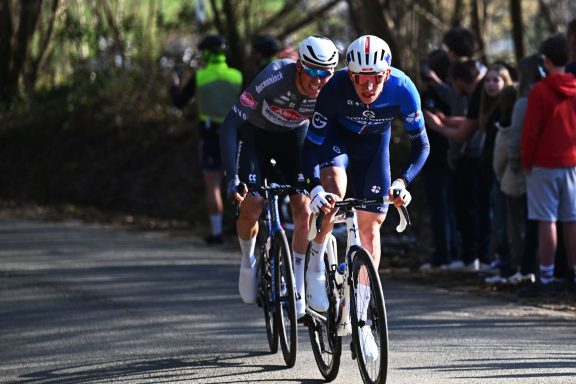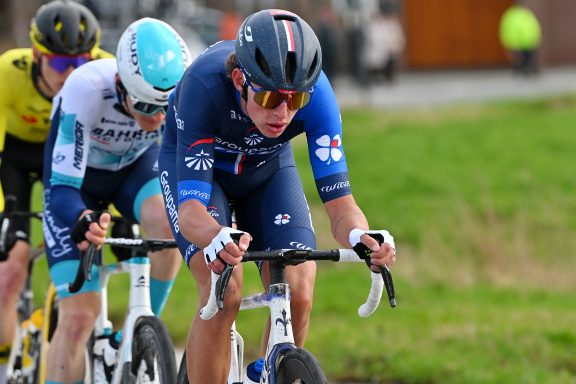

The second race of the Belgian Opening Weekend did finish in a sprint this Sunday, but the 2026 edition of Kuurne–Brussels–Kuurne proved nevertheless quite lively. Johan Jacobs tried to anticipate the big fight by joining the day’s breakaway, but his effort came to an end fifty kilometres from the finish. Axel Huens then took over in a reduced peloton and eventually crossed the line in 22nd place.
The day after Omloop Nieuwsblad, the peloton once again tackled several cobbled climbs at Kuurne–Brussels–Kuurne. However, the race’s history suggested a less selective race, more likely to be controlled by the sprinters. Groupama-FDJ United, on the other hand, had no intention of waiting passively for a bunch finish. “After Omloop, the plan was to adopt a much more aggressive strategy, both tactically and technically, especially in terms of positioning,” explained William Green. “The initial goal was to have Axel in the break, because we know he has a good sprint, and the wind direction today suggested that a small group of favorites could bridge across to the breakaway. In the end, it was Johan who managed to get up the road, and that immediately put us in the race.” After the start in Kortrijk, it took more than thirty minutes of intense fighting before a group of six riders, including the Swiss rider, managed to break clear. “The battle to get into the break was intense, as always at Kuurne,” said Johan. “That’s mainly because the break can go a long way on this course, especially considering the wind direction today.”
“We have to keep moving forward” – William Green
At the front, the Groupama-FDJ United rider enjoyed a maximum lead of four minutes around the mid-race, just before the peloton began to raise the tempo on the Bourliquet climb. “The goal was to stay in front until the first climbs,” William said. “We rode well as a team, which was positive, but unfortunately the legs weren’t quite there once the climbs started coming one after another. After the main climbs, Axel was the only rider from the team left in a peloton of around sixty riders, and he had to race very tactically to save as much energy as possible.” Meanwhile, Johan Jacobs still held about a one-minute advantage at the top of the day’s final climb, the Kluisberg. However, relentless attacks and accelerations in a peloton that had already lost many of the pure sprinters inevitably led to a regrouping. A group of around ten riders first bridged across with 55 kilometres to go, before a larger bunch made contact. “The breakaway could have been a good idea, but the peloton decided otherwise,” said the Swiss rider. “Johan’s presence at the front was positive in any case,” William added. “It’s always important to anticipate, and once he was caught, he positioned Axel perfectly before the key crosswind section.”Then isolated, Axel Huens responded admirably when echelons briefly formed. Despite several attempts to split the race again, the peloton eventually settled down with around thirty kilometres to go, heading toward what looked increasingly like a bunch sprint. “Axel entered the final corner at 800 meters a little too far back,” William noted. “It was the first time he had the opportunity to fight for a result in a Classic. He probably lacked a bit of confidence and may have been slightly too patient, but he’ll learn from this experience for next time.” The rider from northern France was unable to find an opening in the final straight and had to settle for 22nd place at the finish. “We rode the race we needed to until halfway, then the legs made the difference and partly decided the result,” William concluded. “That’s cycling. We’re disappointed, but more races are coming, and we have to keep moving forward. It was certainly a tough Opening Weekend in Belgium, but the goal is for the riders to take the next step, and by sticking to the same strategy, the results will come.”