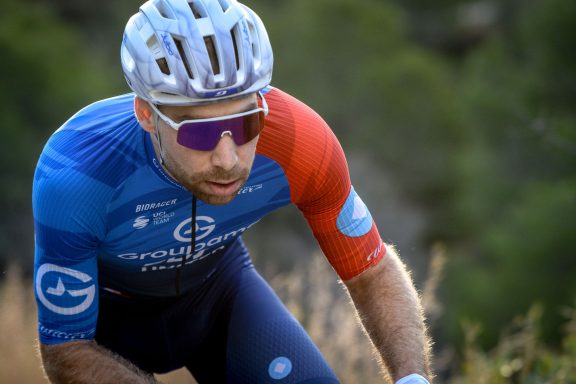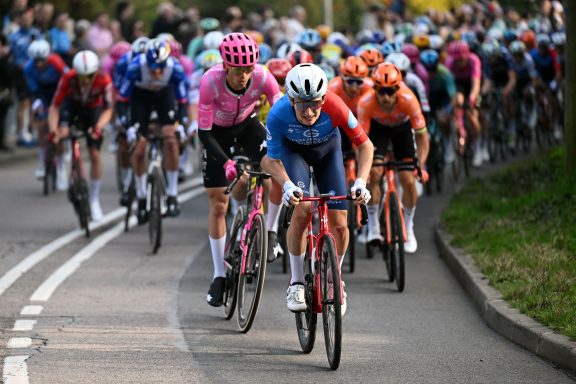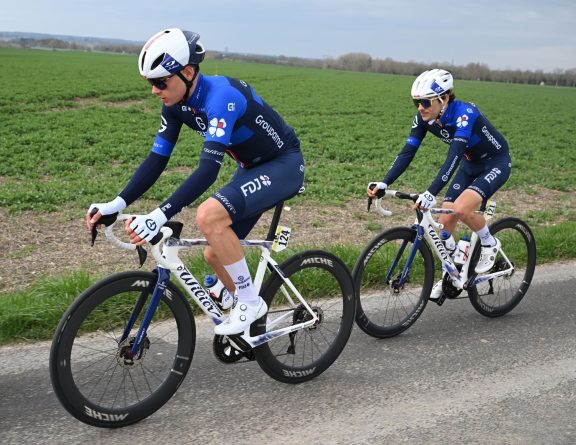

The Groupama-FDJ United cycling team successfully passed the first decisive checkpoint of Paris-Nice this Tuesday. In the 23.5-kilometre team time trial, Rémi Cavagna, David Gaudu, Ewen Costiou and their teammates made the most of their collective strength to secure a solid ninth place, 41 seconds behind the stage winners of Ineos Grenadiers. Before the first climbs appear, the team’s climbers sit around 20th place overall.
As has been the case since 2023, a team time trial featured on the programme of Paris-Nice this Tuesday. A discipline with well-known rules: the classification of each team is determined by the time of its first rider across the line, while every rider receives his own individual finishing time. In the 2026 edition, this format took place over a 23.5-kilometre course. “There was a 2.5-kilometre technical section and then two climbs,” explained team coach Anthony Bouillod. “One came in the first part of the course, the other in the final, after which there was a descent leading to the finish with a final 1,500-metre straight. It was a very fast time trial.” The French squad was among the first teams down the start ramp, with only three teams starting before them. At 3:22 p.m., Cavagna and his teammates rolled out with a clearly defined strategy. “We managed to rotate the entire team through the technical section,” Bouillod continued. “Putting the climbers at the back at that point was not really an advantage because they would have had to respond to all the accelerations. The goal was mainly to have Ewen and Rémi back to the front when we reached the faster sections, so they could set the team back into a good rhythm.”
“It’s a good performance from the team” – Anthony Bouillod
The strategy was maintained throughout the course, as Groupama-FDJ United recorded the second provisional time at the intermediate checkpoint in 15’55. “Everyone took turns on the climbs, even if the strongest riders obviously took longer pulls,” Bouillod added. “But it was mainly in the climb-to-descent transitions where the riders had to adapt so that the strongest riders — namely Ewen and Rémi — could accelerate again over the summit, where they are at their best. We always tried to have them in the right position to allow for a big acceleration.” “I think I was one of the driving forces,” Rémi said. “But the goal wasn’t to ride faster than everyone else and break the team apart. It was more about supporting the others and giving them some relief. The most important thing was not to lose speed. That’s what I tried to do, what we all tried to do as best we could, and I think we handled it quite well. We started fairly cautiously and managed to finish strongly.” At the finish, Groupama-FDJ United set the fastest provisional time in 27’21, before being beaten by four seconds a few minutes later by UAE Team Emirates-XRG.
As the afternoon progressed, the French team gradually slipped down the standings but still managed to remain inside the top ten, finishing ninth, 41 seconds behind Ineos Grenadiers. “We knew we weren’t going to win the stage because we didn’t have a typical time-trial line-up, but we had strong riders and we rode as fast as we could with the team we had,” Rémi said. “We didn’t set a target position but rather a time objective with the general classification in mind,” Anthony added. “We thought we would lose 45 seconds to the winning team. We conceded 41, which is very good and satisfying. As for the position, I think it reflects what we can achieve on a good day with the group we had. It’s a good performance from the team. I’m also quite pleased with the riders because the wind changed slightly compared to the recon, but thanks to all the work done beforehand, especially on the circuit last week, they were able to work together and adapt to the conditions. That was very positive.”After this first crucial day of the “Race to the Sun”, Ewen Costiou, David Gaudu and Rudy Molard now sit 20th, 21st and 22nd overall, 43 seconds behind race leader Juan Ayuso. “David and Ewen showed today that they are in good shape, which is reassuring and will give them confidence,” Anthony said. “We’re now heading into terrain that should be more favourable for breakaways and for our leaders,” Rémi concluded.