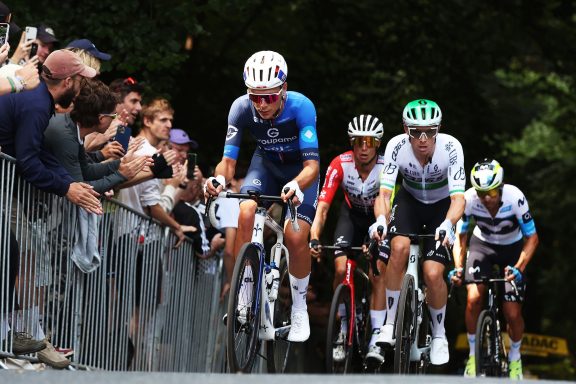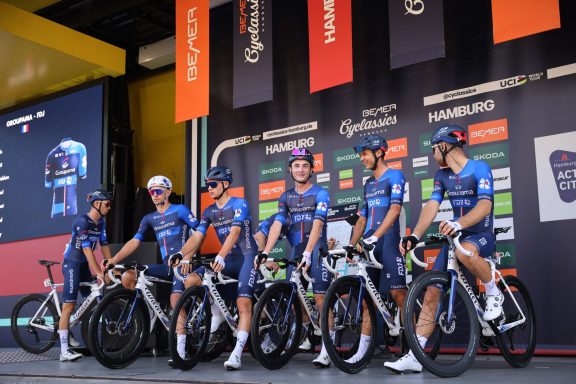

After some frustrating sprints in Poland around ten days ago, Paul Penhoët proved more successful in Germany this Sunday. At the ADAC Cyclassics, the 24-year-old Frenchman managed to contest the final sprint after making it over the final ascent of the Waseberg with the first peloton. He then fought his way through the group over the final two kilometres to give it his all in the finishing straight, where he secured an excellent fourth place: the best result of his career in a WorldTour Classic.
The ADAC Cyclassics, a race that has been part of cycling’s highest level for around twenty years and traditionally made for the sprinters, was set to take place in Hamburg this Sunday. “Since last year, however, they have made the course harder with five ascents of the Waseberg,” explained Jussi Veikkanen. “It has become a little more unpredictable, which is why we wanted to play several cards. The team has often done well here, and we wanted to keep that momentum going. The plan was to keep Axel and Thibaud as our protected riders and have Paul with a free role”. A year after Johan Jacobs’ superb but unsuccessful breakaway attempt, the goal was therefore not to make the morning break. The Groupama-FDJ United Cycling Team instead wanted to wait until the final seventy kilometres before making its presence felt. “It was mainly from the third ascent of the Waseberg onwards that we needed to be there if anything happened,” Jussi added. “Kevin and Johan had been designated for that role, but in the end, no really interesting group managed to form.” With sixty kilometres to go, the peloton caught the two counter-attackers who had gone clear, and it was only one minute and thirty seconds behind the morning breakaway when crossing the finish line located ten kilometres later.
“I’m where I belong” – Paul Penhoët
With thirty kilometres to go, tensions rose again as the riders approached the fourth ascent of the Waseberg, although it did not cause any significant splits. A few minutes later, as expected, the real selection finally took place. With fifteen kilometres remaining, Isaac del Toro launched the attack everyone had been anticipating, but was unable to create any real gap. Thibaud Gruel came over the climb among the first ten riders, with his teammate Paul Penhoët only a few metres behind. “We knew there was a 95% chance it would come down to a sprint,” said Jussi. “Actually, the key was positioning on the Waseberg, and that’s what we had focused on because we knew there would be splits after the climb. That’s what happened to Milan and Kooij, who never managed to get back on. As far as we were concerned, all our best cards were well positioned, and it paid off: they were all up front.” “I knew I was in good shape, so I entered the final climb in a good position thanks to Clément, who brought me back up at the last moment,” said Paul. “I could feel that my legs were still responding well at that point in the race, so I was confident about my sprint.”
Over the final ten kilometres, a group of around fifty riders, including Thibaud Gruel, Kevin Geniets, Axel Huens and Paul Penhoët, broke clear and did everything they could to prevent Jonathan Milan and Olav Kooij from returning. The battle was won by the first peloton, and as the sprint approached, the Groupama-FDJ United fast man first benefited from Kevin Geniets’ support before fighting his way towards the front on his own. “I was focused on being near the front as much as possible, unlike last year, so that I could do my sprint,” Paul explained. After a fierce battle for position, the 24-year-old eventually entered the finishing straight almost on the wheel of favourite Paul Magnier. While Magnier quickly showed that he was the fastest, Paul Penhoët was able to produce a full-strength sprint to secure an impressive fourth place. “I’m where I belong,” he said. “I wasn’t able to move up, but I didn’t lose any positions either. It’s still a good day for me in a one-day WorldTour race.” It was even his best-ever performance in a Classic at this level. “We were left wanting more in Poland, so we slightly changed our strategy here, and it worked pretty well,” added Jussi. “Paul was able to take advantage of the situation, and this will give him confidence for the Tour Poitou-Charentes and the end of the season.”
Axel Huens finished 20th on the day, while Thibaud Gruel was unable to contest the sprint after suffering a dropped chain. “I saw a strong, composed group, and we were still quite numerous in the first group today,” Jussi concluded. “Now we need to maintain this positive momentum and keep the same motivation for the upcoming races.”