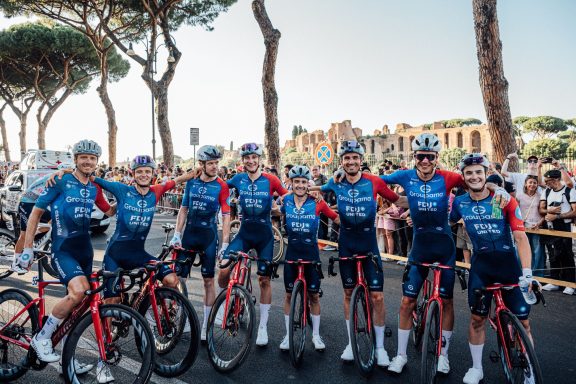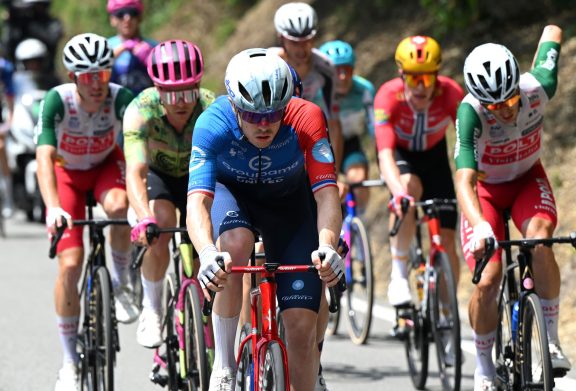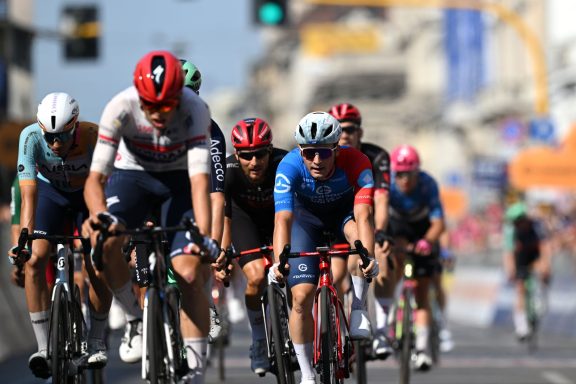

A former essential rider of the Groupama-FDJ United cycling team, William Bonnet is now in charge of race logistics within the organization. Alongside his colleagues, he ensures that both human and material resources are in place so the team can operate optimally in races and training camps. Today, he takes us behind the scenes of the preparation for one of the main events of the calendar: the Giro d’Italia.
From road captain to logistics conductor
My transition into this role came after discussions with the team and the retirement of Martial Gayant, which more or less coincided with the end of my career. It’s a position that interested me because it sits at the heart of the team. You get involved in everything, you’re at the centre of the organization and in constant contact with every department. Going to races as a sports director might seem like the natural next step, but it didn’t particularly appeal to me. I eased into the role gradually. First, I could finish my career at my own pace, and then during my first year of retirement, I came along a few times as a guest, on training camps, at races, or alongside Martial, to understand how the whole organisation was made. Naturally, strong relationships had already been built during my years as a rider, and there was mutual trust. That made things easier. Career transitions are never simple, and they weren’t obliged to offer me this opportunity, so I’m very grateful to Marc [Madiot] and the team.
The first steps
Preparing for a Grand Tour like the Giro begins in winter. Just like for the riders, the staff schedule is set at that time, once the UCI calendar is announced. We already know the staff we’ll need for a Grand Tour. We then meet with the different departments (sporting, medical, mechanical, assistants) to decide who we’d like to have for five major events: the three Grand Tours, the Ardennes Classics, and the Flemish Classics. There’s a selection process, a mild form of competition within the staff for these big events, but we also try to rotate assistants and mechanics across the season. In the end, this part of the organization is quite straightforward. By winter, the schedule is more or less defined up until the Tour, even if adjustments are always possible.
The real challenge comes with the route revealed by the race organizer. When, as is the case this year, the Grand Departure is far from Italy, it naturally makes things more complicated. The difficulty lies in transporting all the equipment, vehicles, and personnel so the team can function properly.
All roads lead to… Nesebar
As the race approaches, the briefing document becomes central. It gathers all key information: who will be there, travel details, flights, ticket references, vehicles available on site, the team hotel, and so on. The goal is for everyone to have their own information while also knowing when others arrive, who picks up whom, and ensuring everyone is in the right place on day one. Further details are then shared, such as the roadbook. Some staff members also contact hotels in advance to prepare specific needs, like food for the team chef.
In a sport like ours, travel is of course highly individualized, as everyone departs from their own home. We need to ensure that a rider living in Nice and another in Brittany both arrive in Sofia on Tuesday at roughly similar times. The idea is to gather everyone, staff included, around the same time and get them to the hotel at a reasonable hour. To give you an idea, our Giro roster includes about fifty people. Around thirty-five will be there throughout, while others will only be present temporarily, such as conveyors, or assistants who will be in Bulgaria but not in Italy, as we also need staff on other races. To cover everything, we rely on regular freelancers in addition to full-time staff.
There’s no fixed rule when it comes to booking travel. Ideally, we’d plan everything well in advance, but there are always last-minute changes. For those confirmed early, bookings start about a month ahead. For others, like riders, adjustments can come at the last minute. Another key aspect is accommodation. The organizer allocates a set number of rooms per team, but all teams exceed that quota. We therefore book additional rooms for each stage (usually five or six), and most of the time, we manage to keep everyone in the same hotel.
The convoy hits the road
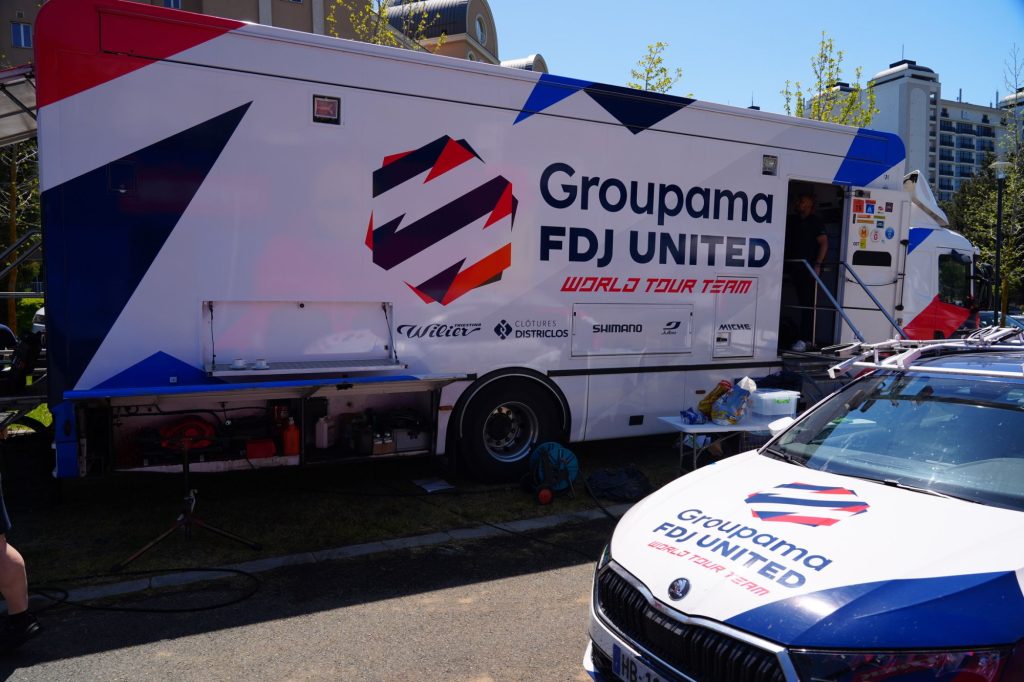
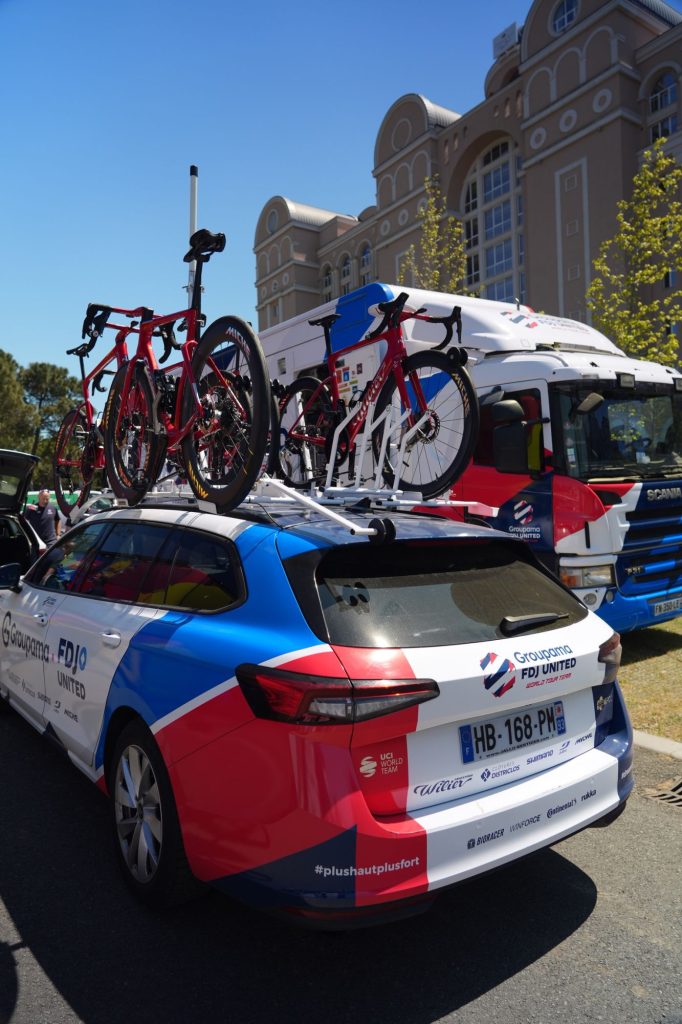
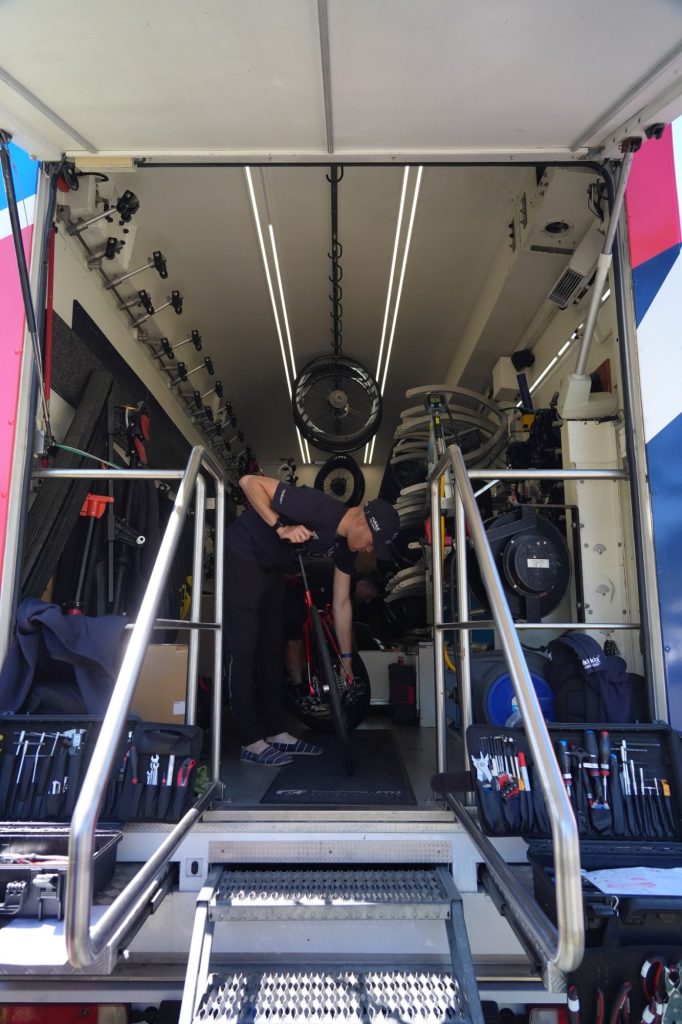
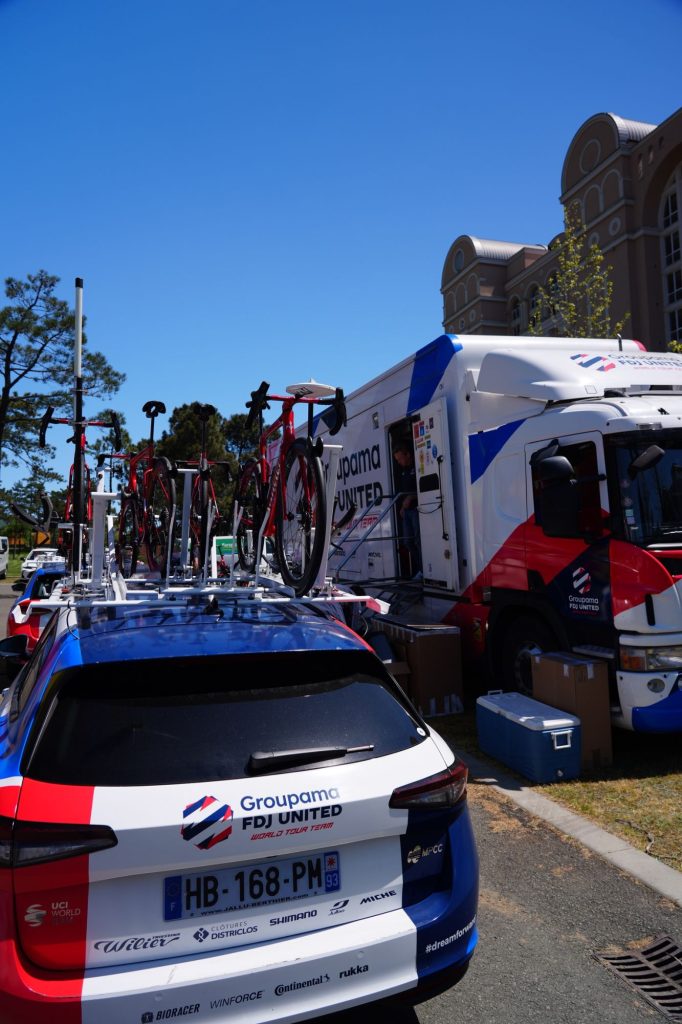
Inventory and restocking of trucks are streamlined as much as possible. Each race has designated mechanics and assistants, and since the season is already underway, vehicles are often coming from other events before heading to the Giro. After each race, inventories are carried out and shared within dedicated groups to ensure proper restocking. There’s strong solidarity within the staff. Everyone knows who they’ll be working with and organizes accordingly. Several assistants and mechanics spent a day or two at the Service Course in Villepinte loading vehicles with nutrition products, coolers, and all necessary equipment.
On the mechanical side, there are also specific challenges. Some riders hadn’t raced in the previous two weeks, making it easy to transport their bikes via truck to Bulgaria. Others were racing at the Tour de Romandie until Sunday. Their bikes only returned to the Service Course on Monday, so instead of sending a vehicle urgently, we flew them out on Tuesday with part of the staff. It’s a constant process of finding solutions to ensure everything is ready on time.
For Grand Tours, we also work with our partner Technisom to provide mattresses. Dedicated staff travel with us to install and remove them in hotels. They too need to come at the Service Course to prepare and load their vehicle. All vehicles are thoroughly checked before departure. We’re never completely safe from issues, but we do everything to ensure they are fully operational.
Delivering the fleet to its destination
For a foreign Grand Départ like this year’s in Bulgaria, we wait to see what the organizer provides in terms of transfers. Last year, for example, the organizer handled the transfer of our fleet of vehicles between Albania and Italy. This year, apart from the staff and riders’ flight on Sunday evening, nothing was arranged. We had to adapt. In practice, we sent a smaller fleet to Bulgaria and a larger, more standard one directly to Italy. This early part of the Giro ties up a large portion of our vehicles, while other races, training camps, and development teams are also running. Managing the fleet is always tricky, but in this case, it becomes a real headache.
Because of the distance, we also rely on drivers to transport some vehicles, such as trucks and motorhomes, to Bulgaria, and others directly to Italy. We also work with a company to transport lighter vehicles on flatbed trucks. This avoids additional fatigue for staff, as the Service Course is 2,500 kilometers away from the Grand Departure. Our teams will spend nearly four weeks on site, which is already demanding, so we try not to burden them further. Transport planning must also account for public holidays and weekends, when certain vehicles are not allowed to drive. Some left as early as last week to arrive on time. Administrative requirements and regulations across different countries also need to be considered.
As a side note, the organizer takes care of around twenty team members for a charter flight from Sofia to Italy on Sunday evening. Others will travel on flights we booked ourselves, while our hospitality team will take a boat with their vehicle. It’s the only vehicle covering both countries, but the journey takes two days: eight hours by road to Greece, 10–11 hours by boat, then another 5–6 hours in Italy. Logistically, it was simply impossible to move all vehicles and be ready in time for the first stage in Italy.
Two sighs of relief
Once everything is underway and everyone has arrived and settled in, things run smoothly. We then deal with any unforeseen issues. On site, one of the three sports directors is dedicated to logistics, which is Jussi Veikkanen for the Giro. We prepare everything together beforehand with him and Melly Fesin, but once the race starts, he takes over. We remain in support, but the goal is for him to have the best possible conditions to operate. Jussi has already been on site for several days, and until the very last moment, we’re still coordinating arrivals, vehicle logistics, and returns. When the first stage gets underway, that’s a first sigh of relief. When everyone reaches Italy, that’s the second. But there’s no real downtime: other races follow immediately.
Once the race is underway, we simply hope everything goes smoothly and that the riders are in good shape. As riders, we’re not always aware of all these challenges, and that’s normal. Just like in my time, the staff’s role is to optimize everything so riders can perform at their best. If our work goes unnoticed, it means we’ve done it right.