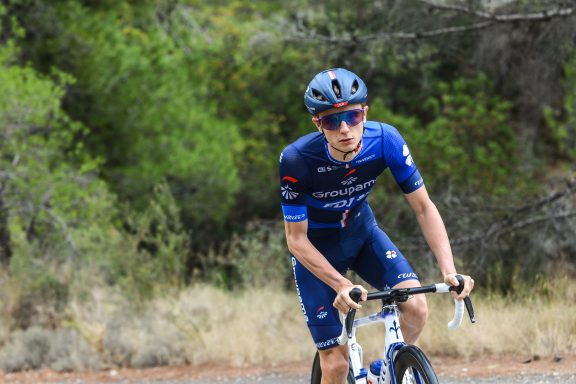

The Groupama–FDJ United development team was ever-present in the U23 edition of Liège–Bastogne–Liège this Saturday. However, in Blegny, after 177 kilometres, Jérôme Gannat’s riders were not rewarded for their efforts and aggressive racing. At the finish, Victor Loulergue took twelfth place in a reduced bunch sprint, just a few kilometers after going all-in with a late attack.
Just over a week before the “big boys”, the U23 riders tackled their own version of Liège–Bastogne–Liège on a very hilly course between Bastogne and Blegny, though with a more manageable final than the elite race. Located around forty kilometers from the finish, the Côte de la Redoute was the last major difficulty on the route. Earlier in the race, however, the “Wanne–Stockeu–Haute Levée” trilogy featured around the midpoint, and quite surprisingly, a large breakaway reached it with a two-minute advantage over the peloton. “There was an initial move of sixteen riders with Esteban Foucher, which was brought back, then after 50–60 kilometres, a rather unusual scenario unfolded as a large breakaway formed in several waves, eventually with thirty-two riders up front,” explained Jérôme Gannat. “We were in a very good position with four riders: Rémi Daumas, Eliott Boulet, Yann Dubois, and Esteban again.” During this sequence of climbs, the lead group was reduced by half, but the French squad still had all its riders at the front.
“An exemplary attitude” – Jérôme Gannat
Meanwhile, the peloton closed in significantly and was less than a minute behind before tackling the famous Côte de la Redoute. “We thought everything would be decided there,” said Jérôme. “Rémi attacked at the bottom but couldn’t get clear. The lead group was also joined by several riders from the peloton, including world champion Lorenzo Finn and Victor. Everything regrouped after a few kilometers, with around thirty-five riders, and we were still in a strong position with five guys.” Shortly after, several riders tried to take advantage of the rolling terrain to gain a gap, including Rémi Daumas. Six riders eventually managed to break clear in the final but were caught just before the final climb of the day, the Côte de Bolland (600 m at 8%), located six kilometres from the finish. “Victor went all-in on that climb,” Jérôme commented. “He really went for it, but he faded a bit at the top.” The recent third-place finisher at the Circuit des Ardennes was therefore unable to break away, and a group of around twenty riders came back together on the descent toward Blegny for a reduced sprint finish.
In that scenario, Victor Loulergue was unfortunately unable to score a great result, crossing the line in twelfth place. “We obviously hoped for better, as he had shown strong sprinting form in the Ardennes,” Jérôme said. “I think his intense effort on the climb compromised his sprint. He was at the end of his strength. He couldn’t sprint properly because he had bravely tried his luck a few minutes earlier. It was still a good move. We always say you need to be aggressive in a final. In hindsight, it’s easy to think otherwise, but at the time he made that choice, and we can’t blame him.” Yann Dubois (18th) also finished in the lead group, while Eliott Boulet, Rémi Daumas, and Esteban Foucher crossed the line one minute later. “We had a very good race,” Jérôme concluded. “We were very active in the breakaways and in the final, but the result didn’t necessarily follow. We came for the win, not for twelfth place, but looking at how the race unfolded, we don’t have much to regret. The team’s attitude was exemplary throughout the day. This race was a real goal, but we were just missing that little extra.”