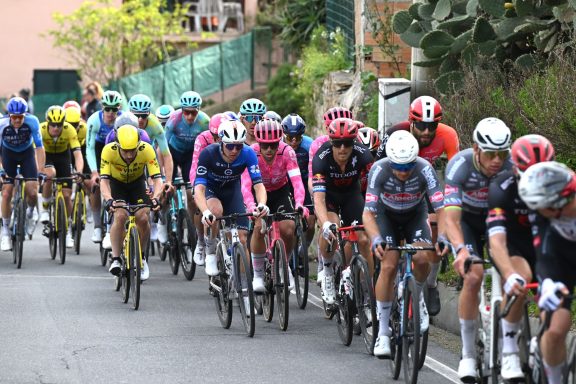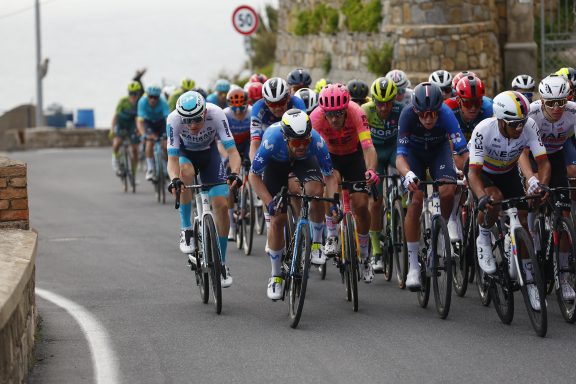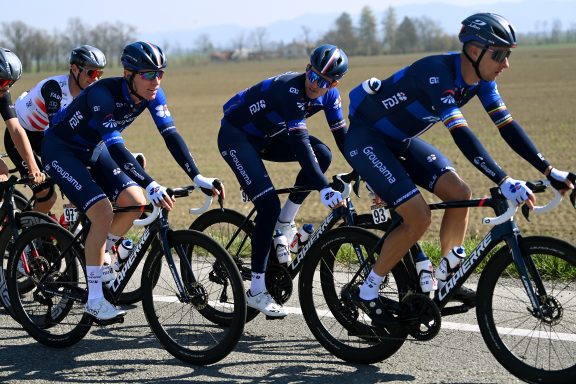

The first Monument of the season did not take the hoped-for turn for Romain Grégoire and the Groupama-FDJ United cycling team. Too far behind Tadej Pogacar when the decisive attack happened on the Cipressa, the young rider from Besançon was, unlike last year, unable to really measure himself against the top contenders in Milano-Sanremo. He therefore crossed the finish line alongside Clément Braz Afonso and Bastien Tronchon in a peloton of around forty riders, claiming 18th place, four seconds behind the world champion and race winner.
This Saturday, the first day of spring coincided—almost naturally—with Milan-Sanremo. As in the past two years, the peloton gathered in Pavia for the start of the season’s first Monument. On the program were just over 300 kilometres (including the neutral start) and a highly anticipated finish through the Cipressa and the Poggio. Several hours before this “money time,” the race began with the traditional breakaway, made up of nine riders in this 2026 edition, which was initially quite controlled by the peloton. However, after the descent of the Passo del Turchino, the fugitives began to increase their gap. “We were used to a frantic pace as soon as we reached the coast in previous editions,” explained Philippe Mauduit. “With the headwind this year, it was a bit more controlled. It only heated up when approaching the Capi.” So much so that, in just three climbs over fifteen kilometers, the peloton closed nearly three minutes on the breakaway. The race then took a very different turn when passing through Imperia, a few kilometres before the crucial Cipressa climb. “Pogacar got caught in a crash, and it further stirred up the peloton,” Philippe added.
“It’s very frustrating” – Romain Grégoire
Within the bunch, the battle for position was still raging as they approached the Cipressa. “Clément [Russo] and Kevin did a lot of work in that regard, which was exactly the plan,” Philippe continued. “We were a bit lost at the foot of the Cipressa because UAE wasn’t at the front,” said Romain Grégoire. “We wondered what was going to happen and if it would come down to a more classic scenario with a decision on the Poggio. Then Pogacar came back from nowhere, and everything immediately kicked off.” As last year, the world champion used his teammates to increase the pace before launching his attack 2,500 metres from the summit and just over twenty-four kilometers from the finish. “I was positioned around 15th–20th, but on the Cipressa, that’s already too far back,” Romain said. Tadej Pogacar brought only Tom Pidcock and Mathieu van der Poel with him, and the trio immediately made the difference on the rest of the peloton. The latter regrouped to about forty riders after the Cipressa descent, including Clément Braz Afonso and Bastien Tronchon for Groupama-FDJ United. In the transition phase toward the Poggio, the peloton led a hard chase behind the leading trio, but at the foot of the day’s final climb, about ten seconds still separated the two groups.
“I thought it could come back together and that I might still hope for something great in the last two kilometres, or by finding a tiny gap in the sprint,” Romain said. “I didn’t give up; I was hoping for a little miracle.” Nevertheless, after dropping Van der Poel, Pogacar and Pidcock reached the top of the Poggio with a fifteen-second lead over the peloton and didn’t hesitate to take turns on the final flat two kilometers leading to the Via Roma in Sanremo. The world champion eventually outsprinted the Brit for the victory, Wout Van Aert took third place after a late attack, and a peloton of roughly forty riders contested the remaining positions. In that group, Romain Grégoire finished 18th, Bastien Tronchon 21st, and Clément Braz Afonso 29th. “I got completely jostled in the sprint and was way too far back with one kilometre to go,” Romain admitted. “I moved up, but starting that far back, I couldn’t have done better. I think I had good legs today, but I don’t really know what to make of my race. I didn’t put in a maximal effort at any time; it felt like I was following all day without really being an active part of the race. It’s very frustrating.” “I don’t think he did what he wanted to today,” Philippe added. “We didn’t come here for this. The scenario wasn’t what we had dreamed of, but we have to adapt. That said, the guys were courageous and fought with what they had today.”